Author: Adrian Granchelli
-
 Accreditation in Research and Publications
Collaboration is incredible beneficial to everyone involved. It invites more ideas, thoughts, perspectives, that deepens understanding and strengthens the output. In academia, this is of utmost importance to truly understand a subject area, ensure that personal biases are addressed, and to develop a strong output. Collaboration is not only beneficial, it can also be advantageous…

-
 Exploring an Alternative Dissertation Assessment Rubric
I am surprised to find a lot of ambiguity in not only how a dissertation is assessed but also on what the purpose of a dissertation is. If we are to employ backward design for the dissertation, then we should start by defining the learning objectives, then the assessment strategies, and finally the learning activities. …
-
Exploring Alternative Dissertation Precedence
The format of an alternative dissertation needs to match both the purpose of the final product and research subject. I am drawn to the visual nonfiction medium (or ‘coffee table book’) for the ability to leverage visual hierarchy, typography, colour, and images to communicate ideas. This medium is far more accessible than the traditional APA…
-
Exploring My Potential Dissertation Medium
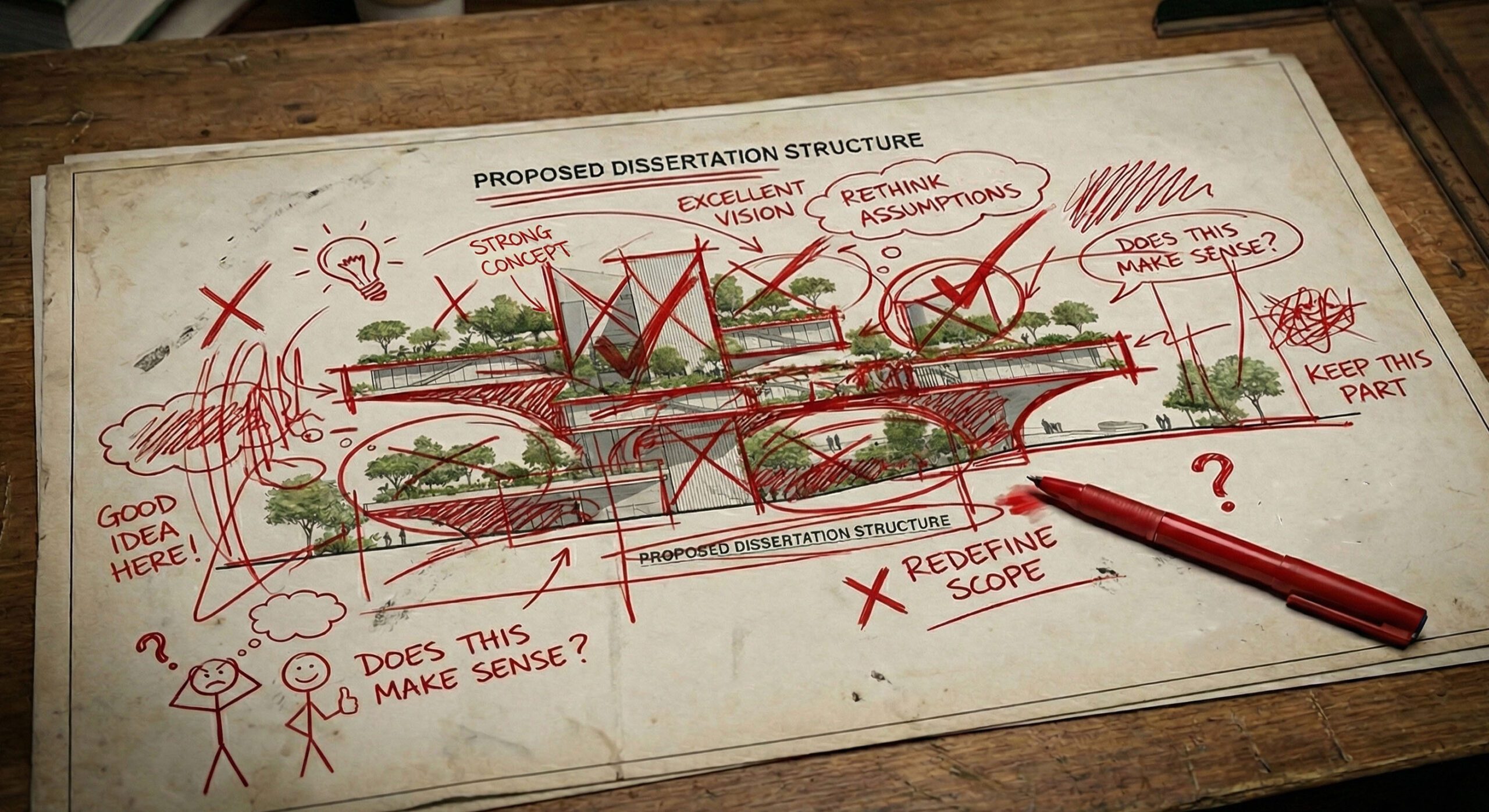
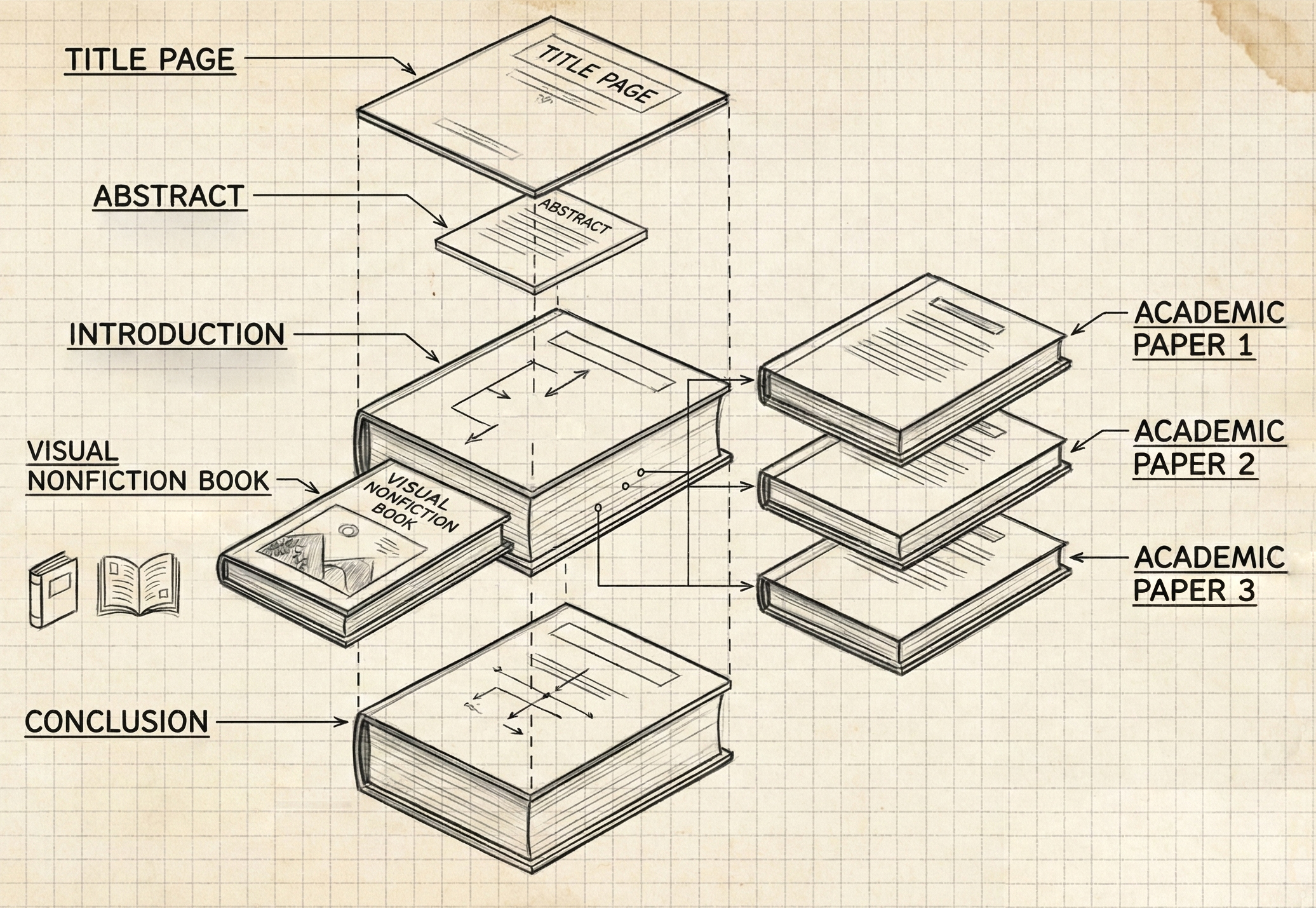
The Dissertation Norm The traditional dissertation format is to translate doctoral research into a 200+ page manuscript that strictly adheres to the APA guidelines: a title page, double-spaced text, a subtle text hierarchy, etc. Aesthetically, it is lifeless, and from my understanding, lifeless it lives in a university library archive where very few people read…
-
Assessing Writing of Undergraduate Students in a GenAI World
The final phase of the Double Diamond design process is to converge the solution space, ultimately to one final solution for the problem. Within the problem space of assessing writing of undergraduate students in a generative artificial intelligence (GenAI) world, the problem to solve is: “How can we make the learning that occurs while writing…
-
Assessing Writing of Undergraduate Students in a GenAI WorldDesign Process · Education Practice & Theory · Generative Artificial Intelligence · PhD in Educational Technology · User Experience
I am exploring the problem space of assessing writing of undergraduate students in a generative artificial intelligent (GenAI) world through a double diamond design process. I first explored the problem space in order to better understand the problem, in Attempting to Define a Wicked Problem, before converging on a singular problem statement, in Converging a…
-
Exploring Affordances and Limitations of Generative Artificial IntelligenceDesign Process · Education Practice & Theory · Generative Artificial Intelligence · PhD in Educational Technology · User Experience
Good designers need to engage in many perspectives, oftentimes simultaneously. That is, the ability to move fluidly between different frames of mind throughout the process, from managerial to focused and from divergent to convergent. Additionally, strong and confident design emerges from the ability to integrate and leverage external support and diverse perspectives—to see things how…
-
Assessing Writing of Undergraduate Students in a GenAI WorldDesign Process · Generative Artificial Intelligence · PhD in Educational Technology · User Experience
Using the Double Diamond design process, I began exploring the problem space of assessing undergraduate writing in a generative artificial intelligence (GenAI) context. I examined the literature and conducted simulated stakeholder interviews to understand the extent and nuance of the challenge. You can view the whole journey here: Attempting to Define a Wicked Problem. This…
-
A Literature Review
-
Insights for Shaping My Own Dissertation
I reviewed three dissertations related to my interests to gain an understanding of what the final product of my own dissertation may look like. I initially searched for process-oriented assessment practices and process pedagogy. Somewhat surprisingly, this resulted in dissertations mostly in writing education. From my current understanding, process pedagogy can be applied across disciplines,…