I am surprised to find a lot of ambiguity in not only how a dissertation is assessed but also on what the purpose of a dissertation is. If we are to employ backward design for the dissertation, then we should start by defining the learning objectives, then the assessment strategies, and finally the learning activities.
Setting the Objective
Without a clear purpose defined by my own department, I have looked to others for guidance. The UVic School of Nursing offers the purpose of the dissertation proposal and oral defence (which may be extrapolated to the purpose of a dissertation) as a demonstration of competence in:
- familiarity with the literature in the research area
- familiarity with fields related to the research area
- ability to justify the need for the proposed research
- ability to defend the research design
- ability to defend the methods for data collection and data analysis
- ability to reason and integrate during the questioning
The University of British Columbia Graduate School outlines the following description:
A dissertation is expected to represent a significant contribution of new knowledge achieved through systematic investigation. It conveys the scholarly context, methods, results and an analysis of your original scholarship. It is expected to represent an original contribution to new understanding, either through the uncovering or creation of knowledge or understanding, through the integration and synthesis of knowledge across perspectives or fields, and/or through the application of knowledge to address tangible problems. It is intended to demonstrate your ability to:
- Critically analyze the relevant literature and background
- Use and describe in detail the appropriate methodology for the scholarly work undertaken
- Conduct research and present findings that result in a significant and original contribution to knowledge
- Verify knowledge claims and sources meticulously
- Locate the work of the dissertation and its findings within the broader field or discipline
- Communicate the scholarly work and analysis effectively
Matt Might offers an illustrative guide to a PhD, focusing on the purpose of extending human knowledge.
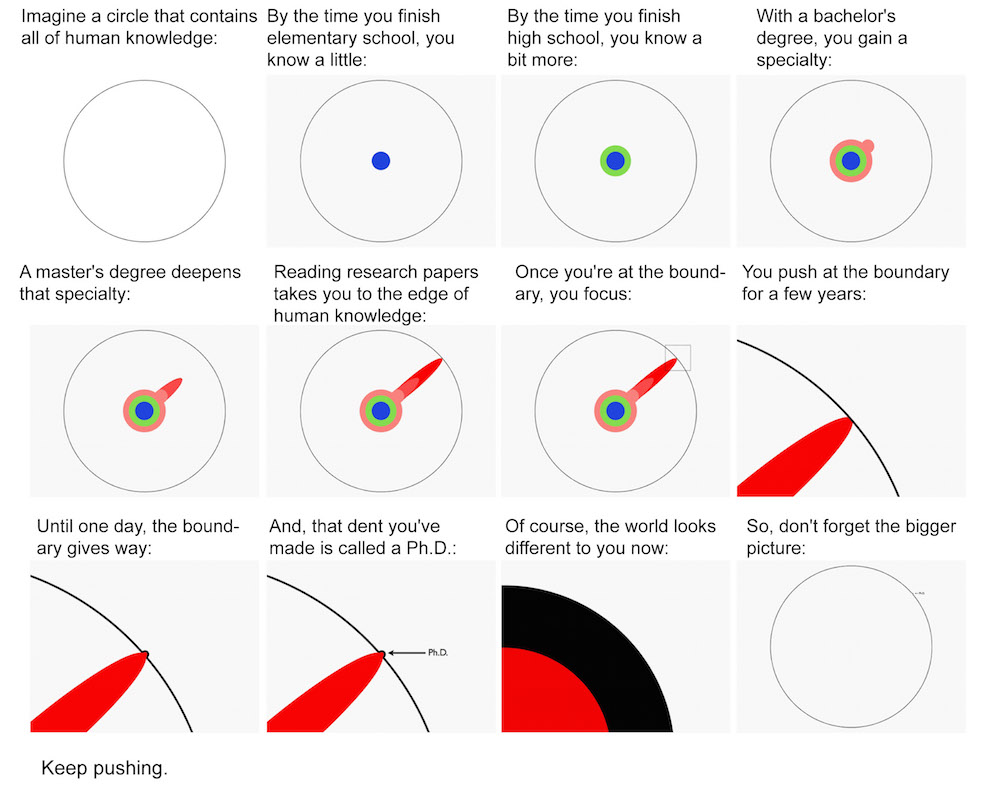
So my working purpose for a PhD and its artifact, the dissertation, is to:
- Demonstrate mastery of a subject area
- Demonstrate mastery of a research methodology
- Conduct research that offers an original contribution to knowledge
- Communicate this mastery and new knowledge effectively
Assessment Strategy
The Department of Curriculum and Instruction Graduate Handbook does not offer specifics on how the dissertation is to be assessed. It states “for PhD and MA programs, the role of the examining committee is to assess the dissertation or thesis and to conduct an oral examination based on that dissertation or thesis.” It also requires annual progress tracking including objectives “set by the student in consultation with supervisor”.
As an alternative format, the visual-nonfiction dissertation is neither listed in the Graduate Handbook nor aligned with the Thesis and dissertation format requirements for final submission to the Faculty of Graduate Studies. Nevertheless, this format effectively fulfills the objectives of a dissertation and may provide a superior medium for communicating the research.
Next-Generation Dissertations offer a format-agnostic assessment rubric to support the evaluation of alternative dissertations organized into five categories: scope, research, analysis, contribution to the field, and product quality. This rubric can be a foundational starting point to develop a more tailored, project specific rubric. Next-Generation Dissertations offer further guiding questions that emphasize the purpose of the dissertation and its evaluation while challenging traditional norms:
- What methodological skills does a successful dissertation need to demonstrate in your field?
- What content or subject-based expectations are there for a dissertation in your field?
- What, if any, formal/structural components are essential for your field? Be selective. For instance, clear and informative citation is essential, but is a specific citation style truly necessary?
- Would these requirements hold equally well for a standard dissertation?
Link to the full article: Evaluation by Next-Generation Dissertations.
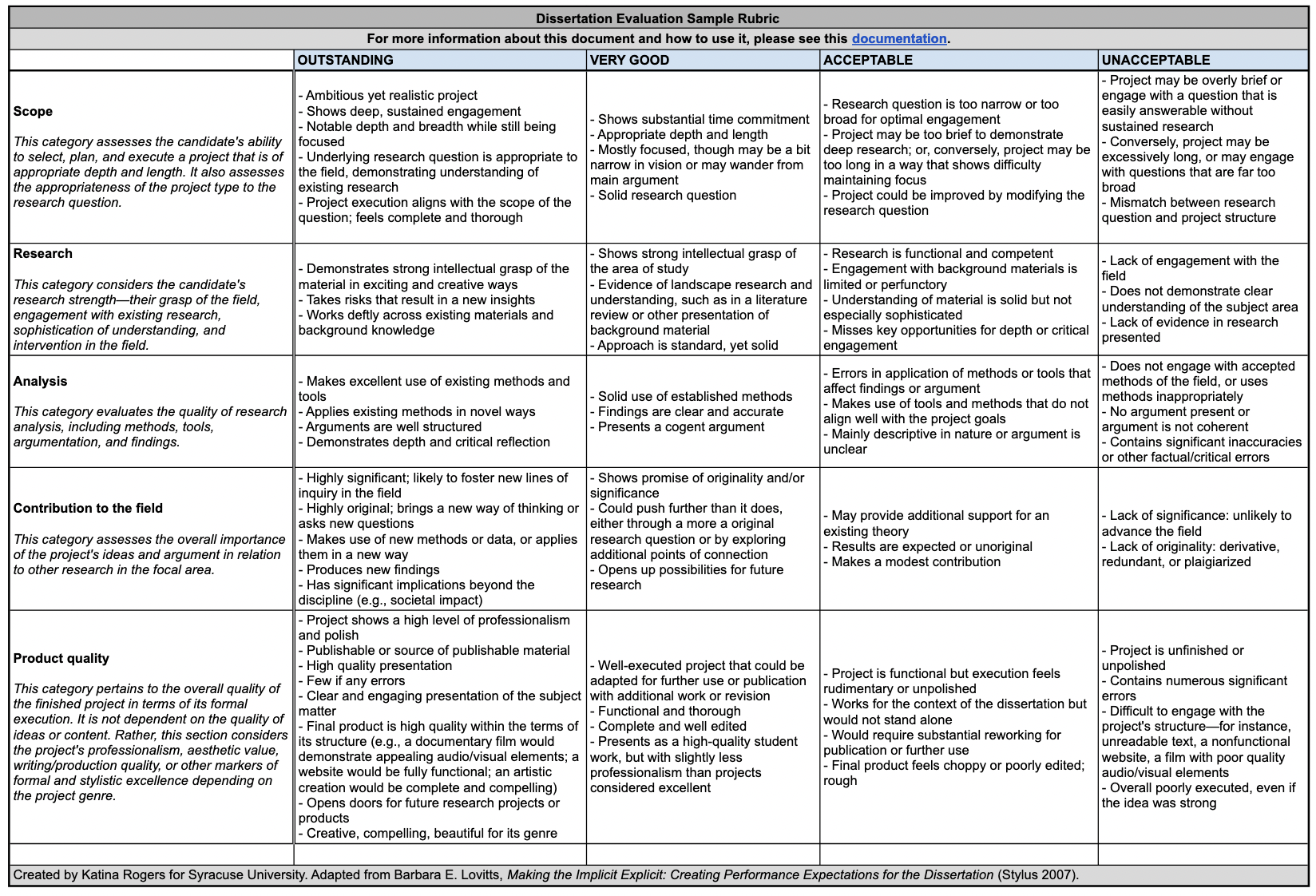
Created by Katina Rogers for Syracuse University. Adapted from Barbara E. Lovitts, Making the Implicit Explicit: Creating Performance Expectations for the Dissertation (Stylus 2007).
Comparing Next-Generation Dissertation assessment rubric clearly assesses the the core objectives of a dissertation. The only criterion that may differ from a traditional dissertation and a visual-nonfiction dissertation is product-quality. A traditional dissertation may assess adherence to APA7 guidelines while a visual-nonfiction dissertation may assess accessibility, style, text hierarchy, and complimentary communication through imagery. In this context, Mayer’s Cognitive Theory of Multimedia Learning1 may provide the framework for the product quality criterion.
Next Steps
I view this blog post as the start of a discussion in co-creating my alternative dissertation with my supervisor and future committee. I believe that a visual-nonfiction medium is a suitable format for an educational studies dissertation that meets the objectives of a dissertation and can be adequately assessed. The above rubric shared on Next-Generation Dissertation offers a foundational starting point in developing an assessment framework for my specific dissertation.
References
University of British Columbia. (n.d.). Scope of UBC theses and dissertations. Graduate and Postdoctoral Studies. https://www.grad.ubc.ca/current-students/dissertation-thesis-preparation/scope-ubc-theses-dissertations
University of Victoria. (n.d.). Dissertation proposal and oral defence: Advancing to candidacy PhD program. School of Nursing. https://www.uvic.ca/health/nursing/students/resources/dissertation-proposal/index.php
Footnotes
- Mayer, R. E., & Fiorella, L. (2021). The Cambridge Handbook of Multimedia Learning (3rd ed.). Cambridge University Press. https://doi.org/10.1017/9781108894333