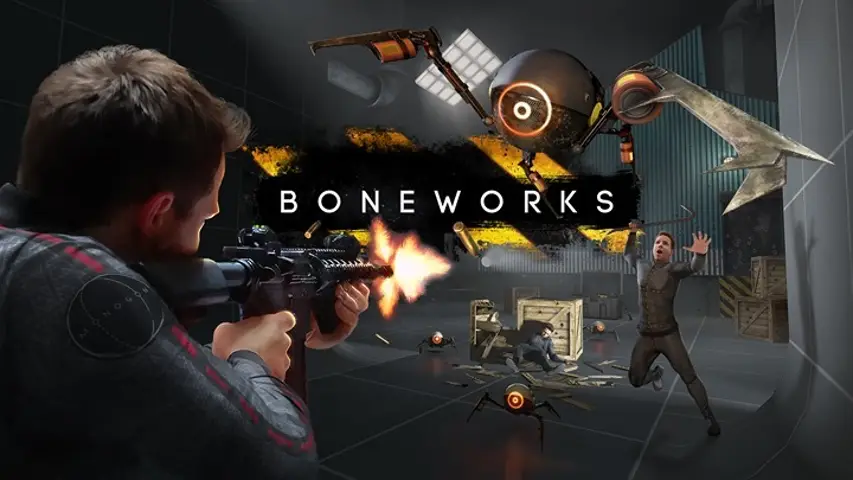
This research project was part of ETEC 565D: Digital Games and Learning1 in the Master of Educational Technology program2 at the University of British Columbia. The task is to evaluate a video game through three distinct data collection phases:
- game advertisement and promotional materials (before playing the game)
- the personal experience of playing the game
- watching other people play the game
Thank you Julian and MakeItZone for your patience and letting me play the VR system and game, especially during this time of heightened restrictions.
And great recommendation Tristan 🙂
SESSION 1: BEFORE PLAYING
Introduction and Summary of Expectations
I expect BONEWORKS to be an immersive virtual reality (VR) experience of creative physics based puzzles and exciting action packed conflict with various weapons and techniques to master in the first-person perspective. I expect there to be a steep learning curve to learn the VR game mechanics but my experience of first-person shooter games will prove to be valuable and ultimately, I will likely enjoy the game.

Virtual Reality (VR)
I chose to play a virtual reality (VR) game as this new platform is very interesting and without a doubt will have a significant role in shaping the future of video games. I am further interested in VR as my experiences are limited to three occasions with a total ‘play’ time of less than an hour.
My first time trying VR was a roller coaster simulation and I don’t like roller coasters. I was standing as the virtual roller coaster went higher, and higher, and higher, climbing a mountain to give perspective. It reached the top and went straight down. This virtual world gave my stomach a very real feeling of vertigo. The roller coaster took a huge turn and I lost my physical sense of gravity and the person offering the simulator caught me from falling. Overall, it was an incredible experience that illuminated how your mind can be tricked resulting in physiological and real affects.
The second time playing VR, I tried a first-person zombie shooter game. I have played many first shooters with the subject of zombies before, such as Left4Dead 2. However, in the virtual reality version, it was so much more immersive that I was really scared to keep moving. This game is set in an abandoned and dark subway station. The player has to walk and progress forward with only a headlight to see – so you can only see where you choose to look. This feature had me walking through the level extremely slowly so that I can scour the environment for zombies or anything that wold jump out and attack me. I was legitimately scared to move forward unlike my experience in other non-VR related games.
My third foray into VR was a ‘social’ experience. Players were invited into a VR space to connect and experience the art of the virtual world together. I found social interaction quite lackluster and awkward but found the art engaging as it was interesting and exploratory in nature.
Access to VR, in the current time, is a significant barrier for most players, costing more than $1000 CDN for some setups in addition to a powerful, gaming computer. I am lucky to have access through a local makerspace to a powerful VR setup.
Game Choice: BONEWORKS
With the question of choosing a VR game, I asked a teenage friend at the makerspace, who recommended BONEWORKS. They described the game as “It’s like Portal but there’s guns and monsters.”
I loved the games Portal as well as Portal 2, additionally, BONEWORKS has “very positive” reviews (Stress Level Zero, 2019), so I will take their recommendations and play this game.
About the Game
Retrieved from the Steam store (Stress Level Zero, 2019):
BONEWORKS Is a narrative VR action adventure using advanced experimental physics mechanics. Dynamically navigate through environments, engage in physics heavy combat, and creatively approach puzzles with physics.
- Advanced Physics: Designed entirely for consistent universal rules, the advanced physics mechanics encourage players to confidently and creatively interact with the virtual world however you want.
- Combat: Approach combat in any number of ways you can think of following the physical rules of the game’s universe. Melee weapons, firearms, physics traps, environments, can all be used to aid you in fights with enemy entities.
- Weapons, lots of weapons: Boneworks provides players with a plethora of physics based weaponry; guns, swords, axes, clubs, spears, hammers, experimental energy weapons, nonsensical mystery tools, and anomalous physics weapons.
- Interaction: Hyper realistic VR object and environment interaction.
- Story: Play through the game’s mysterious narrative and explore the deep inner workings of the Monogon Industries’ artificial intelligence operating system; Myth OS.
- Character Bodies: Accurate full 4K body systems built from the ground up provide a realistic looking body presence and allow for a maximum level of immersion with physical interaction in the game space.
ATTENTION: This game demonstrates advanced VR mechanics and concepts, players are recommended to have previous VR experience and understanding of common VR gameplay principles before proceeding.
Mature Content Description
The developers describe the content like this:
Physics based enemies that can be interacted with and dispatched in a multitude of violent ways based on player’s actions. Realistic and potentially disturbing enemies will enter player’s space.
BONEWORKS’ promotional video (Stress Level Zero, 2019):
What will I like / dislike about it?
I really enjoy physics based puzzle games. I hope the puzzles employ realistic physics.
I may find the game stressful, which tends to be heightened in VR environments. I hope it is not stressfully debilitating.
I hope the violence is not too close and realistic as that will also add to the stress and heighten a discomfort in gameplay. Violence, to a certain extent, I find easy to compartmentalize and ‘ignore’ as fake but video games are getting more and more realistic. The realism along with the immersive qualities of VR may make the violence too ‘real’ for comfort.
What will I need to do in it?
From the game description and promotional content, it appears that the player will have to overcome physics based puzzles and defeat opponents in a ‘test facility’ environment. I will need to utilize weapons and tools and perform a sequence of operations to defeat each challenge.
I may be biased from the Portal storyline, but the description of the BONEWORKS story, seems very similar to Portal. The player may first start completing objectives that the ‘test facility’-like environment poses, but begin to distrust the whole system, where the overall objective is to uncover the truth. The BONEWORKS story appears to be intentionally vague.
I imagine the objective will fit into the ‘escape’ (to get the character to safety), ‘outwit’ (to gain or use knowledge in a way that defeats the opponent), and/or ‘capture’ (to take or destroy the opponent) categories (Fullerton, 2014).
What will I need to learn within it?
The game recommends “to have previous VR experience and understanding of common VR gameplay principles before proceeding” (Stress Level Zero, 2019). I imagine there will extensive use of VR game mechanics that will be needed to master in order for the player to comfortably and skillfully navigate the player’s avatar through the conflicts that arise. At times my lack of experience with VR principles will be frustrating and very stressful if an action has to be taken under constraint or within a certain time frame (i.e. to overcome an enemy). I am a quick learner when it comes to games and mechanics and I do not foresee this as a large barrier.
Each video game has its own set of rules defining game play that must be learned. In video games, these rules are encountered gradually, as game play and skill are scaffolded. Only after a player has played for sometime do they understand all the rules within the game. Challenges within video games are presented where certain skills must be utilized to overcome them. Often times, challenges become increasingly challenging by requiring a creative use of skills or outlook on the rules of the game environment. Some games repeat these challenges over and over again, or combing multiple different challenges as the game progresses. This creative manipulation of the game world can be referred to as ‘game logic’ and each game will have its own way of thinking that must be learned to master the game.
What will it be like / similar to (other games I have played)?
Prior to playing the game, BONEWORKS, appears to be similar to games I have experience with and some that I have really enjoyed playing.
BONEWORKS is in the first-person shooter genre. Some games I have played in this genre include the Portal, James Bond, Left4Dead, and Call of Duty games. These games all involve the use of various weapons, violence, and action sequences.
The puzzles in BONEWORKS are described to be approached creatively with physics (Stress Level Zero, 2019). The puzzle aspect may be similar to the Portal games, which are also first-person shooter games with a heavy focus on physics based puzzles. The Legend of Zelda games also offer many puzzles, at times that are physics based.
Another game it may be very similar to is Bioshock, which I have only played briefly but built an understanding of it by extensively observing a friend play. Bioshock has many similarities to BONEWORKS, from its genre, a first-person shooter, to the use of various weapons, and even special powers such as telekinesis which can be used to manipulate the environment in creative ways. The storyline of Bioshock is also strewn in mystery as the player explores an abandoned city and strange way of life.
SESSION 2: AFTER PLAYING
Introduction and Summary of Experience
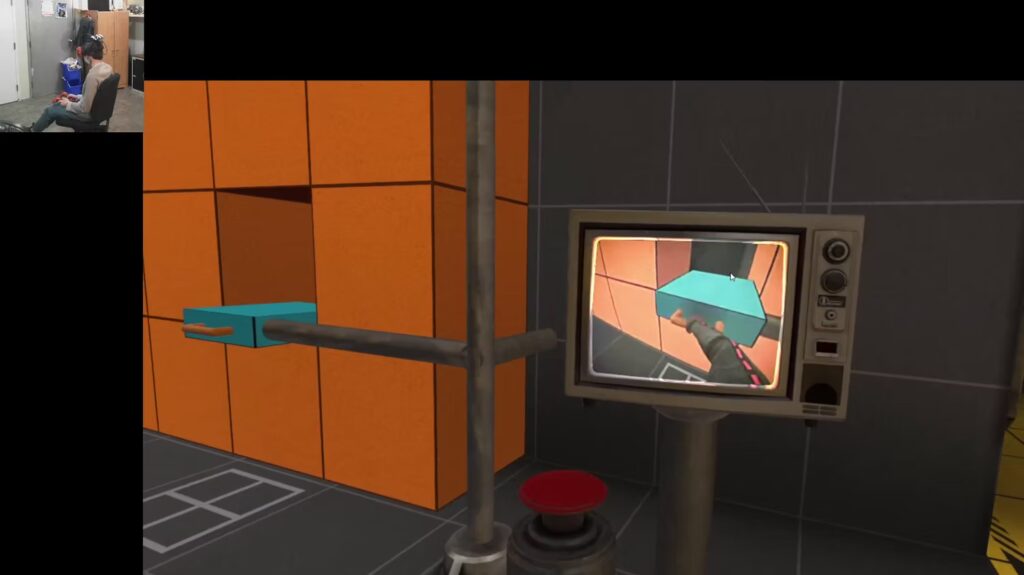
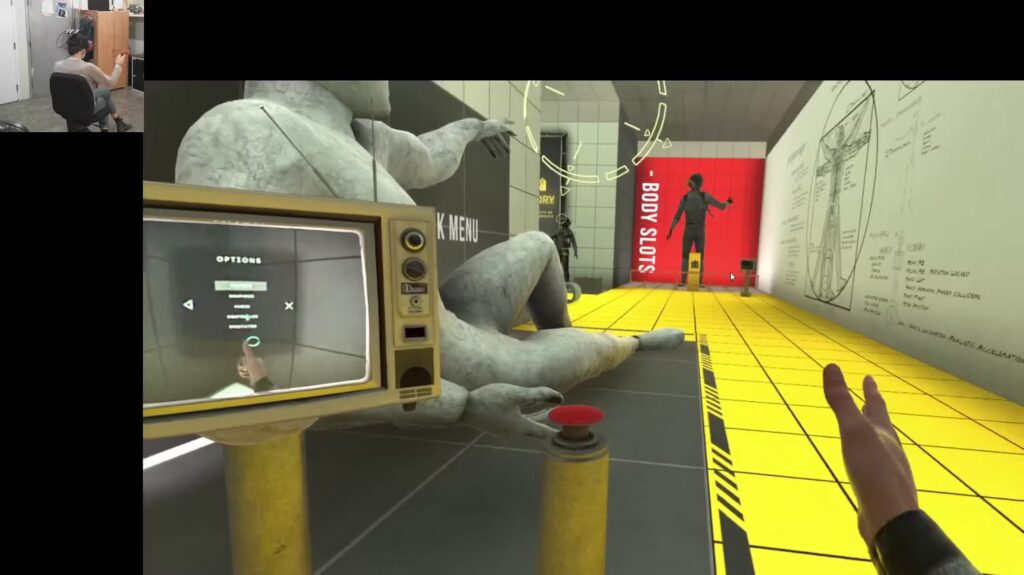
BONEWORKS is an intuitive game that encourages exploration and only implies direction and goals which provides the player with a sense of freedom. The player is first introduced to the story and general gameplay, motivating the player to want to learn, and only after is the player brought through the ‘Museum of Technical Demonstration’, where controls, game mechanics, and common tools are exhibited in a manner where players are free to interact (and learn) or skip and move on.
Descriptive and Affective Notes
GAMEPLAY SESSION 1
Virtual Reality took a long time to setup and get going. From the system setup to the loading times.
Immediately it recommends ‘expert’ VR experience – that is intimidating!
LEVEL 1
The game had an interesting hook right at the beginning – putting you into a future world where the player enters virtual reality. This brought me in.
It was a really nice balance of exploring how to play before you were told. However, some game components and necessary interactions were introduced that needed a better explanation. The exploration was fun but where my intuition of gameplay lacked was frustrating. Maybe more experienced VR players would already know the standard mechanics?
Initially, there was a simple task to ‘reach out with your hand and grab the object in front of you’. I had no idea what to do and struggled, frustratedly, for five minutes or so. I was supposed to squeeze the buttons of the controller to ‘force grab’. I tried every button I was accustomed to from ‘traditional’ video game controllers. Once I figured that out, thanks to the internet, controls were more intuitive, such as throwing objects once you’ve held them. They were intuitive but not always natural, through interacting with these controls.
The game got some creepy elements, once I left the beginning spot. The music set the dystopian and unnerving tone. Arms fell from the ceiling upon pushing a button. I felt more nervous than explorative. I searched for and found a weapon in a locker.
I really liked how things are hidden in this game, like easter eggs to find. You can pick up and read clipboards, or stop and check out the posters. A fine sense of detail.
Walking into walls in VR plays an incredible trick with the mind. It is super uncomfortable. It feels wrong and greatly contributed to my stomach ache.
The first time I died in game was from walking into steam. There was no sign that it would kill be except for, I guess, common life sense. No health user interface is present, so I was unsure the threshold to dying or if I get hurt if my health will regenerates. Dying in the game was intense and not a pleasant experience, nor should it be, the entire screen shutters closed into blackness as if you are closing your eyes really slowly while trying to keep them open. Very realistic to slowly sleeping or passing out.
The game doesn’t explain things well and upon reflection, this first level is supposed to be easy and explorative as the next level is a walk through of controls and the following is more challenging with higher risk. Nice scaffolding.
Even though this first level is explorative in nature, I was nervous to try things. The creepy tone made me extra cautious.
LEVEL 2 – MUSEUM OF TECHNICAL DEMONSTRATIONS
I really appreciated the form of a museum for a how-to play introduction. It is not a step-by-step, where one must complete each skill in order like many games, and is open ended where the player chooses how much to interact. I find how-tos quite boring and was happy to skip through it quickly. It definitely reminded me of a museum, a place filled with information, and being drawn to certain exhibits.
The one control I had a lot of trouble with is jumping. I did not quite figure it out.
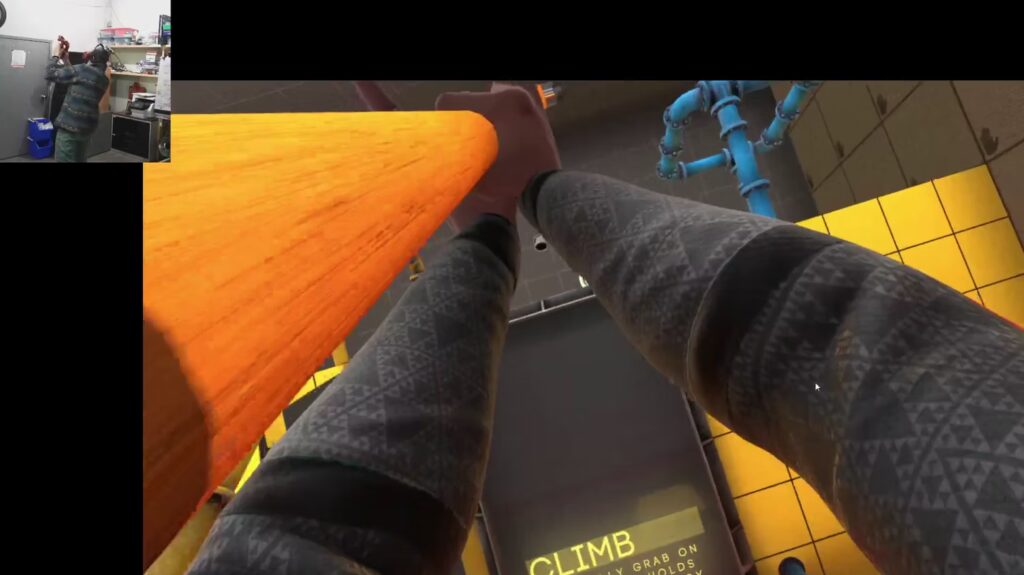
The climbing gym room was great and showcased some of the physics. It started with jumping about one story down, which in VR lifted my stomach. In traditional video games, falling off buildings is something that is very detaching. In VR, it invoked a physical falling sensation – I braced for the landing.
I then grabbed onto a rope pull, and again got nervous from the height, and mimicked how one would hold onto a rope pull, in the ready position.
Moving heavy objects was difficult. Similar to the way walking into a wall is extremely unnerving in VR, moving big objects was also not very friendly on the VR world, as my physical body did not agree with the movement in the VR world.
I experience so much motion sickness, I have to stop playing after only about 30 minutes. Then the motion sickness still got worse and worse. Apparently, walking in a VR world is a large contributor. A lot of VR games have the first-person character ‘warp’ instead of walk. This is why the game asks for your real world height, and other room characterstics in the start of the game. It is an effort to make the VR world as closely as possible mimic your real-life experience of walking.
GAMEPLAY SESSION 2
LEVEL 2 – MUSEUM OF TECHNICAL DEMONSTRATIONS – CONTINUED
I tried sitting this time in hopes it would make the motion sickness better.
Immediately, I picked up the controls again and they felt more comfortable.
I really enjoyed the physics puzzle. The chill music made it fun and easy going. This was still the museum setting and there was an instructional video had I wished to watch it or if one ever got stuck. Jumping was still my awkward control. Walking up really high made that height sensation feel real. Climbing was very awkward and unnatural. It was a fun challenge, and I really enjoyed how my body was part of the puzzle, not too dissimilar to sports, however this world is virtual.
The shooting range was fun. Reloading was a manual motion. Aiming as well is a difficult task. In other first person shooters, all that is needed to be aimed is the crosshair on the target, however in this VR experience, where your head moves, the player has to lineup the crosshairs with their player’s eyes to line-up the shot. Each gun had a different loading, cocking, and holding technique.
I don’t understand why there was so much warning to the advanced physics rooms. I found the time control super interesting. In this case, even though my real world and virtual world were in discrepancy, by changing the time, it was still comfortable. I moved slower in real life with the virtual feedback. Also in the room with different gravities, I adjusted. This is interesting, especially compared to the fact that walking into walls, a spatial disagreement, induced strong motion sickness, but a temporal or physics disagreement did not.
I love the balloon gun!
LEVEL 3
I am in the waste area. There are bodies of old exhibits strewn around and the curious little robotic balls which have come up a couple of times. Here is where the game gets creepy again and my sense of adventure diminished. I was cautiously curious.
In a run-down playground, I tried looking around but didn’t find much of anything.
I get inside a building the music stops and the lack of music adds to the tension. There is a wall with a standing exhibit thing that is not friendly, and I feel powerless with no weapons, nor an understanding of my health. It kills me. It’s really uncomfortable. Not fun.
Second try, I grab a weapon immediately and kill it. Still it is uncomfortable and not fun.
The next room is open and has sensory enemies, they see you they shoot. These enemies are not scary to me. It does end up killing me but it was more of a pleasant experience than fighting the previous one.
I decide to stop before my motion sickness gets too bad. It is not as bad as the first time, but still prevalent.
Analytic Notes
The game presented problems of game play in an open manner. It tells the player in a way, these are all the tools available, and if the player wants to engage there are instructions to do so. This gives the player autonomy and a sense of motivation from the self.
The overarching goal at the beginning is to progress through the level and the driving motive, at least for me was curiosity to explore. There is a great sense of mystery and suspense from it.
The protagonist of the game is a white male. Other than that, antagonists or enemies are either robots or genderless mannequins. Violence is a theme in the game, however, this far into the game it is only used on non-discriminating, though human-like, characters.
This game approached learning the controls in a fun way. Players are encouraged to experiment and reflect. The game also offers nice scaffolding by starting with very simple challenges, with no-stakes, and slowly adding more controls, and in-game considerations.
BONEWORKS is very playful. There are no defined tasks and it is an open environment. There is a defined path to follow and an implied task to reach the end, however, exploration was my primary motive.
SESSION 3: GAMEPLAY OBSERVATION
Introduction and Summary
BONEWORKS is a game with significant breadth and depth of interactions in all aspects, from the story, to the environment, and to overcoming challenges that are presented, providing ample diversity and replay-ability. Players turn their attention to scarce resources, such as ammunition, and eliminating enemies which are not the primary objectives of the game but do play a significant role in the primary objective of reaching the end of the level.

Observed videos:
another video was used, but has since been removed from YouTube.
Descriptive Notes
My first impression is that these players are very comfortable with the game controls. While I am fumbling with the controls and exploring this new environment, terrified of enemies, these players are seamlessly moving in their environment.
The levels are quite the maze and it is not always logical the direction to go. There is a lot to explore in each level. The players particularly focus on collecting ammunition. This appears to be a valuable and scarce resource.
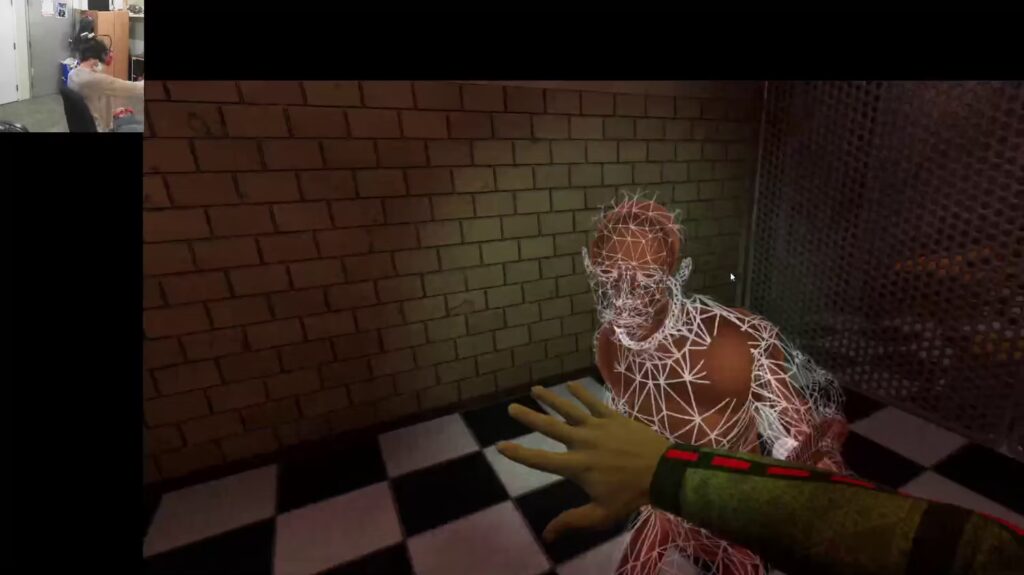
The name of the genderless, wireframe enemies are called nullmen.
The walkthrough, skipped much of the details in the game world. They seemed to already know the tasks and general direction to go. While the other streamer was more explorative in the world, curious, and invested in the storyline/determining what is going on. The game, allowing for the freedom of exploration and with a task appeals to a broader range of players – this game has depth.
There is an incredible amount of interaction in this game. Almost everything in the world can be interacted with or utilized.
The lack of user interface makes it feel more real. It looks as if you are looking through the player’s eyes. While playing this felt frustrating since I lacked the understanding of my personal stats, or relevant concerns such as remaining health, in watching the game, the lack of display makes it more engaging and feel like a real video.
Affective Notes
One player is very curious. They add commentary to their play where they sound very interested in the story, puzzles, and environment. The question of ‘What is going on?’ is a common theme in this game. The mystery of the story line appears to very enticing.
They are also discussed being scared or creeped out. The music plays a huge role in adding to the unnerving atmosphere. A player once said they were prepared for a jump scare from entering into a dark corridor. These players however feel very comfortable dealing with enemies and enemies do not provide a large hurdle to overcome.
Frustration at times with controls was evident. Both streamers at different instances retried the same simple jump multiple times, sometime spending over five minutes on the exact same maneuver.
Throughout the game, players are encouraged to experiment and try the tasks, however the game has instructions or hints riddled in the environment, such as on clipboards or spray painted on walls. These instructions are seamlessly integrated with the environment and add to the tone and mystery.
One player voices that they are sorry about killing multiple times. The violence appears to be uncomfortable for some, though they continue to play through it.
I moved far less confidently through the environment than these players. The controls and lack of skill in VR may have a large impact on my confidence. These players are also not deterred from the fear of the game. The scary aspect however, can be very engaging and elicits an emotional response.
Analytic Notes
Problems such as puzzles and dealing with enemies was evident. Puzzles, in which direction to go in the game or how to get past hurdles are the first obvious problems. Players just tried going in a direction and seeing where it will take them. At times when the puzzles are difficult, there are clues riddled in the environment.
Combatting enemies is another problem of the game. Players utilized tools at their disposal such as guns and weapons to ‘outwit’ opponents. Other options are to avoid enemies.
BONEWORKS does not go into discriminatory issues such as race, gender, or class and the players provided no commentary on such things. However, of all the streams that were available online, BONEWORKS, is played by males. Virtual Reality is expensive which also limits who can play.
On the topic of violence, some players do not interact in any way differently with utilizing violence as any other puzzle in the game. Other players commentate that they are sorry for killing the nullmen. The nullmen, or the enemies, do not have any characterizing features of race or gender, however, they are distinctly resembling a human.
Watching the game really showcased the ways in which it is possible to interact with the game environment. It is a very expansive game world. There appear to be many different ways to overcome the same problem. There is a lot of breadth and depth in this game that allows beginner and expert players to interact in various ways that appeal to higher skill.
BRIDGE: UNITING THE SESSIONS TOGETHER
BONEWORKS is a virtual reality (VR), first-person shooter, single player game where the player is dropped into a mysterious and engaging story. Players are faced with a diverse range of problems from physics based puzzles to aggressive enemies. The game world has been carefully and finely designed, integrating the visual, audio, and story into one seamless and complimentary experience.
VIRTUAL REALITY
VR provides an almost complete field of view of digital media that is responsive to your head movement in order to simulate a realistic virtual environment. VR is more engaging than traditional media but can invoke physiological effects such as such as nausea or dizziness (Lavoi, Main, King, & King, 2020).
The immersive experience that VR creates is what interested me but unfortunately became a barrier to play. VR can induce ‘cybersickness’ – digitally induced motion sickness – where the player can feel symptoms including “nausea, pale skin, cold sweats, vomiting, dizziness, headache, increased salivation, and fatigue” (p. 103), which has a strong negative effect on game experience (Rebenitsch & Owen, 2016).
STORY
BONEWORKS begins the story and game with the playable character putting on a VR headset which immediately relates the player’s real-world experience with their in-game avatar. The story continues to be interwoven in the entire experience influencing game objectives, tone, and ultimately, player engagement.
GAME OBJECTIVES
The story of BONEWORKS is shrouded in mystery which leads to inexplicitly defined game objectives. Players intuitively explore the environment led by curiosity and subtle guidance. BONEWORKS does not fit neatly into a single objective type as defined by Fullerton (2019) and instead is a combination of many.
‘Escape’, to reach the end of the level, is the overarching objective however it is never directly stated. Instead, players intuitively play towards the end of the level based on prior knowledge of first person shooter video games – that there is a starting point and an end point.
‘Exploration’ is a key objective that motivates players to search and interact with the game world as they uncover the storyline. Advanced players may become uninterested with the ‘Exploration’ objective and instead focus on other areas of gameplay.
However, navigating through the game presents many points of conflict such as physics based puzzles (‘Solution’ objective), enemies that must be avoided or destroyed (‘Capture’ objective), and opportunities for collecting items both useful in gameplay or just for the sake of collecting.
BONEWORKS is a very complex game involving many different objectives. The game objectives are left ambiguous and the player has the autonomy and freedom to play BONEWORS how they would like to. This ambiguity provides a breadth and depth to gameplay that is fun for beginners but remains engaging for experts.
TONE
The tone of BONEWORKS is strategically constructed to engage with the emotions of the player and is constant flux. The whole environment shifts between mysterious and creepy to playful and intense with the use of architecture, colour, and music. These shifts can impose a strong affective response in players, especially due to the immersive qualities of VR. Experienced players may be accustomed to such experiences and remain less affected.
While the breadth of the tone can sustain novelty, not all players may respond positively to all of the tones. Personally, the creepy moments of BONEWORKS were off-putting as I recognized hesitation, discomfort, and disengagement working against my curiosity and desire to continue playing and exploring the game world.
Violence is another controversial tone integrated throughout the game. Players must avoid or defeat human-like enemies through hand-to-hand combat, guns, or other weapons. Although the enemies are non-discriminating, as they lack defining audial and visual features defining race, gender, or class, the enemies distinctly resemble humans. Acts of violence may insight negative emotions such as guilt or remorse as was commentated by A Wolf in VR (2019) during their gameplay.
LEARNING TO PLAY
BONEWORKS implies numerous rules of gameplay through the standards in VR games and its genre of a first-person shooter. Players must use their intuition for even the basic formal elements such as objectives, procedures, and conflict. Experienced video game players will likely succeed in such an environment but the lack of direction may pose as a barrier to novice players.
Scaffolding is present for more advanced gameplay techniques and rules. Players are first exposed to gameplay in a no-stake environment where the tone is light and actions do not have negative repercussions. Instruction is offered, but in a non-imposing way, allowing the player freedom to engage with instruction or not. New techniques, items, and conflict is added throughout the game to meet the player’s level of competency with adequate challenge – too little challenge and a player may feel bored while too much may lead to frustration and anxiety (Figueroa-Flores, 2016).
Signalling, the emphasis of key details (Devers, Devers, & Oke, 2018), is also prevalent in BONEWORKS. When a player is missing a key interaction, components are illuminated signalling that interaction. Additionally, subtle hints are interwoven into the environment such as graffiti.
Learning to play BONEWORKS may feel effortless to experienced VR players since BONEWORKS employs standard VR techniques, follows the first-person shooter genre rules, offers gameplay instructions in a non-intrusive manner, and presents signalling only as needed or camouflaged in the environment.
ENGAGEMENT AND CONCLUSION
BONEWORKS celebrates player autonomy and provides multiple means for engagement and motivation. Players may be engaged by the story, objectives, puzzles, conflict, or exploration and the relaxed structure of BONEWORKS, allows ample freedom for play (Fullerton, 2018). This diversity creates a flexible environment that allows BONEWORK to be appropriate to a variety of people (Tobin, 2014).
Barriers for entry and hurdles to gameplay do prevail. VR is expensive, limiting players by class and can induce cybersickness. A lack of practise with VR or first-person shooters could lead players to frustration or anxiety. Players may be scared or shy away from some of the more intense tones of the game while the violence can induce discomfort and guilt. These and other negative emotions act to demotivate players (Dumont, Istance, Benavides, & Groff, 2010).
BONEWORKS has developed an engaging world riddled with a depth of interactions and promise of discovery motivating players through mystery, intuition, and freedom.
References
A Wolf in VR. (2019). BONEWORKS | Part 2 | WHAT IS WITH THE MELONS??. [Video]. YouTube. https://www.youtube.com/watch?v=PF96ckqkZ1c
Devers, J. C., Devers, E. E., & Oke, L. D. (2018). Encouraging metacognition in digital learning environments. In D. Ifenthaler (Ed.), Digital workplace learning: Bridging formal and informal learning with digital technologies (pp. 9-22). Springer International Publishing AG. Retrieved from https://link-springer-com.ezproxy.library.ubc.ca/book/10.1007%2F978-3-319-46215-8
Dumont, H., Istance, D., Benavides, F., & Groff, J. (2010). The Nature of Learning: Using Research to Inspire Practice. Centre for Educational Research and Innovation. Retrieved June 1, 2019, from https://courses.library.ubc.ca/get/course/122769/hash/i.FxZbz8
Figueroa-Flores, J. F. (2016). Gamification and Game-Based Learning: Two Strategies for the 21stCentury Learner. World Journal of Educational Research, 3(2), 507-522.
Fullerton, T. (2014). Game Design Workshop: A Playcentric Approach to Creating Innovative Games, NY: Taylor & Francis (CRS Press)
Lavoie, R., Main, K., King, C. et al. (2021). Virtual experience, real consequences: the potential negative emotional consequences of virtual reality gameplay. Virtual Reality 25, 69–81. https://doi.org/10.1007/s10055-020-00440-y
Rebenitsch, L., Owen, C. (2016). Review on cybersickness in applications and visual displays. Virtual Reality 20, 101-125.
Stress Level Zero (2019). BONEWORKS. Steam. Retrieved February, 14, 2021, from https://store.steampowered.com/app/823500/BONEWORKS/
Tobin, T. J. (2014). Increase Online Strudent Retention with Universal Design for Learning. The Quarterly Review of Distance Education, 15(3), 13-24.
Footnotes
- Digital Games and Learning course created by Dr. Jen Jenson and Dr. Suzanne de Castell. https://blogs.ubc.ca/565d/
- Master of Educational Technology. University of British Columbia. https://met.ubc.ca/