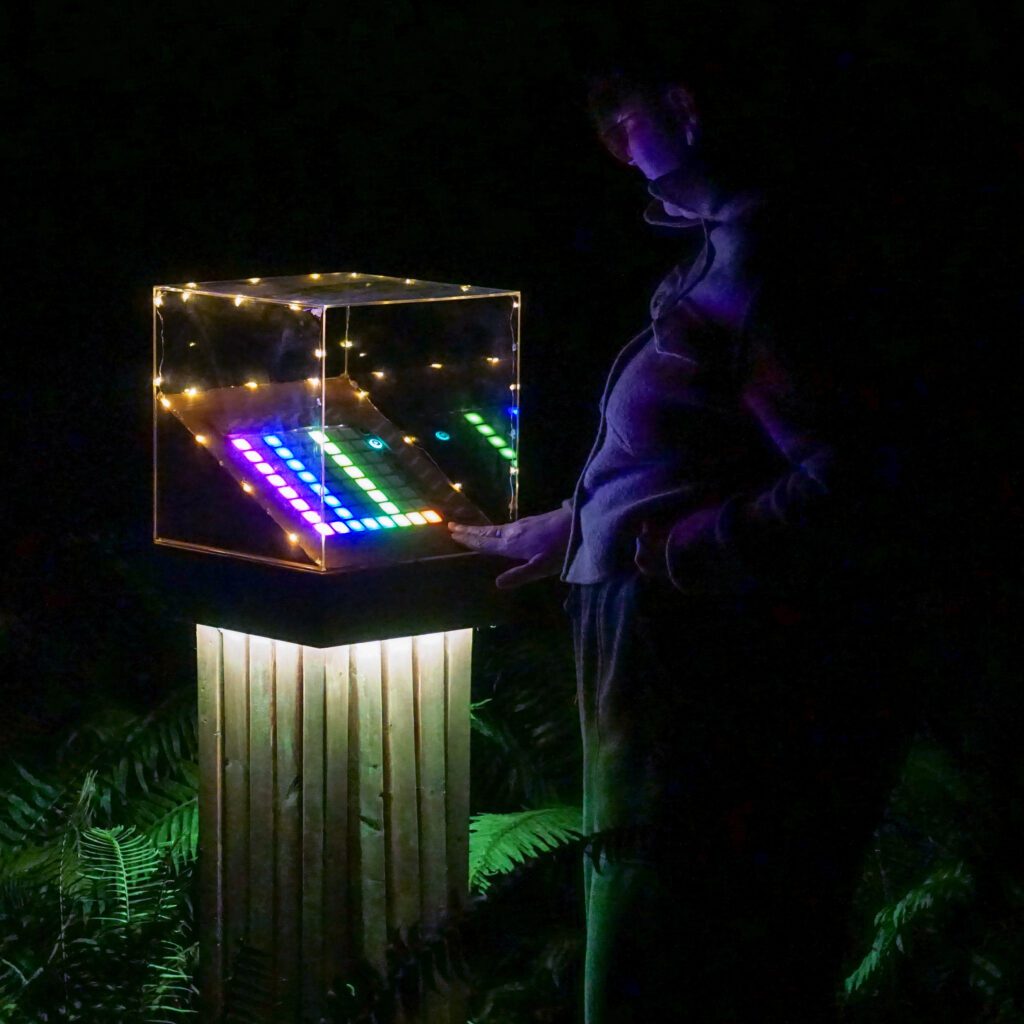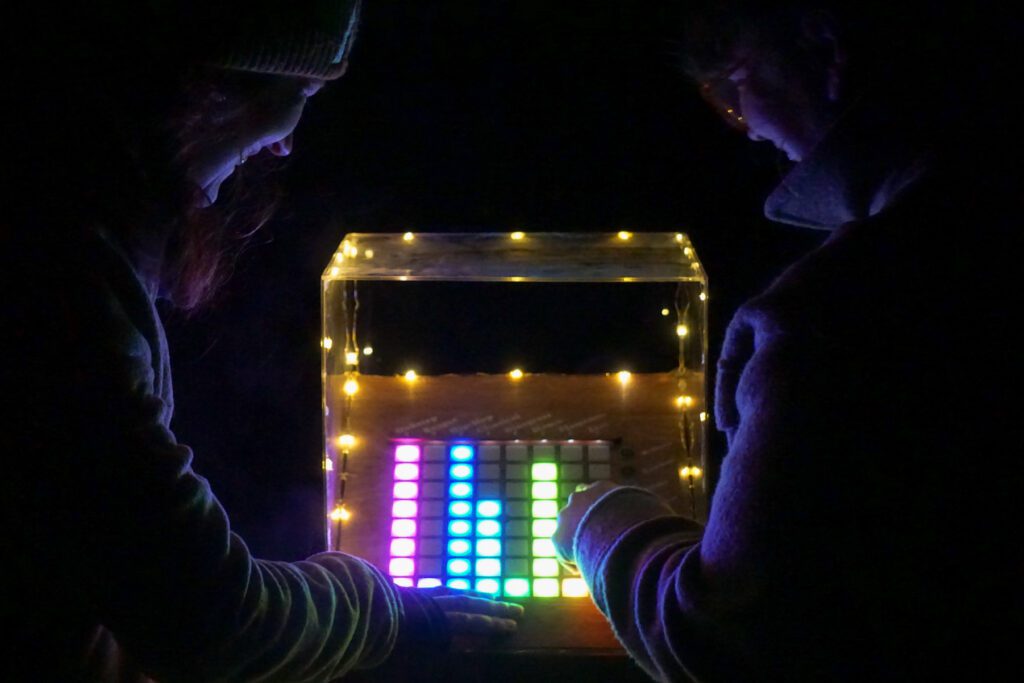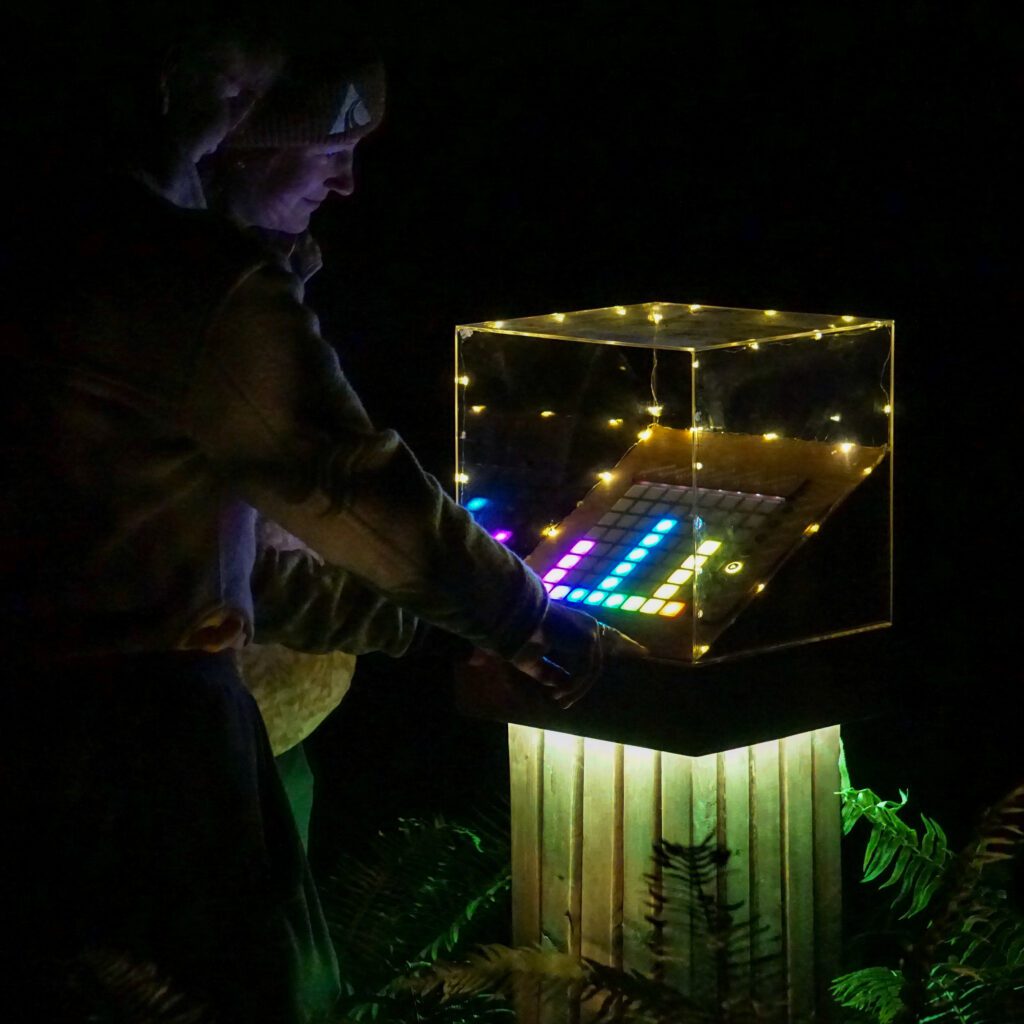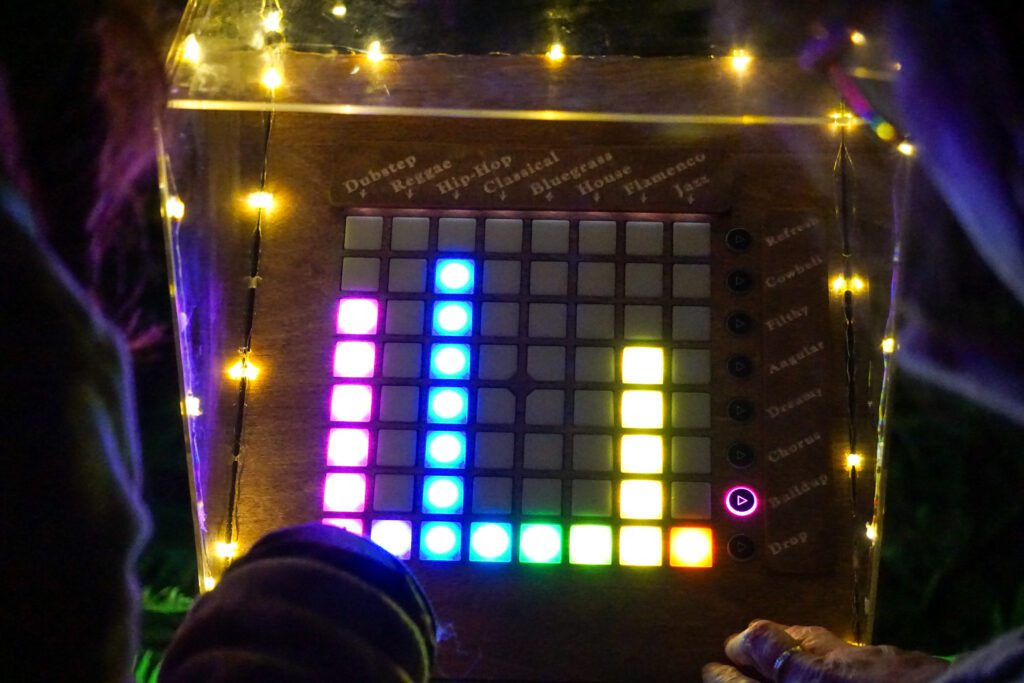
Sonic Tapestry is an interactive art installation that invites participants to cocreate music with a generative artificial intelligence (genAI). The music is AI-generated in real time based on a number of prompt options from a button grid such as ‘Hip-Hop’, ‘Jazz’, ‘Chorus’, and ‘Cowbell’. This piece is highly engaging and interactive, inviting participants to play, experiment, and explore, as the created sounds are always unique and changing. Speakers and sound-reactive lighting highlight the evolving experience while the structure is deliberately rustic in contrast to the high-tech underlying digital system. Sonic Tapestry is an accessible and fun exploration of human-genAI cocreated content that not only allows music-making to be intuitive and easy, but also raises questions about authorship, artistic expression, and the future of genAI use.
GenAI in art is a rightfully controversial topic; as it should be. My perspective on this project is that Sonic Tapestry is an art experience that uses genAI to enable something that would not otherwise be feasible to create. The emphasis here is on music as a medium for exploration, play, and interaction.
Watch / listen to how it works and remember to turn on your audio!
Generative Artificial Intelligence and Art
Firstly, there are an enormous number of copyright violations when companies steal peoples’ works to use as data for training GenAI. This is inexcusable.
When considering the other aspects of GenAI in art, I see more grey areas. Generally, it is worth exploring with powerful, useful technology as it is emerging as a necessary 21st century skill.
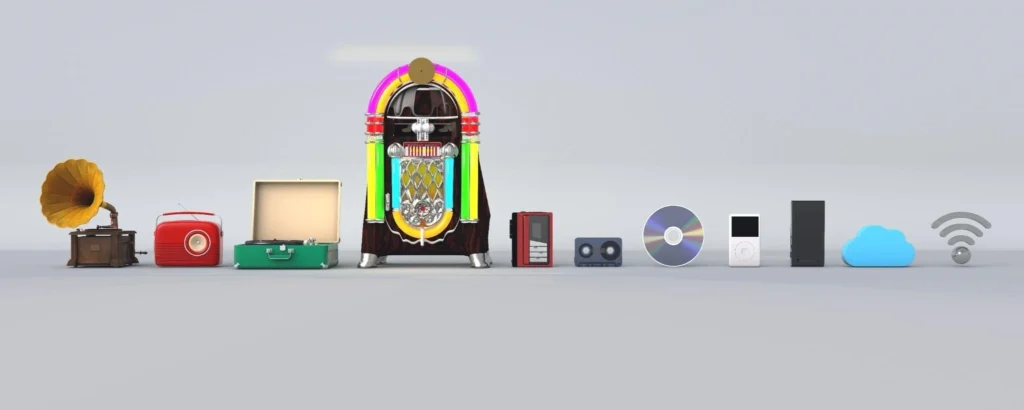
When the gramophone was first introduced, some predicted it would mark the end of live concerts. Instead, it expanded access to engage with music, inspiring demand and leading more people to become musicians. This pattern has continued with each subsequent technological shift, each with its own opportunities and growing pains. Today, streaming services offer vast libraries of music at a low cost. Improvements in usability moved music from the concert hall into the home, and eventually into portable, personal devices that allow listening anywhere. At the same time, new tools have reshaped how music is created and performed, while reconceptualizing instruments in the digital age. DJs and producers now craft live experiences using turntables, synthesizers, and digital production equipment. With each advancement, music has become more accessible, giving individuals greater choice in how and where they listen.
There are also trade-offs to this democratization of music. As the range of available musical experiences expand, attention becomes more fragmented, and individual artists may receive less engagement and compensation for their work. Previous staples to musical performance, such as the bandstand (those abandoned mini stages found around cities), often fall out of use. GenAI further accelerates this shift by lowering the barrier to creating music. While this opens up new forms of expression, it can also devalue the music-making process, especially when compared to the time and skill required to master an instrument. The flood of content being produced (at times genAI slop) is enormous, making it difficult for individual works to stand out or find an audience.
A more hidden and insidious drawback is the homogenization of art. GenAI is based on statistical probability; that is, it draws from all its training data and creates the most common patterns. A statistical average often promotes what is popular and not necessarily what is true nor accurate and usually not the quiet nor marginalized voices. Over time, this could lead to art that is strikingly similar. Yes, genAI will accelerate this, but the capitalist driven music industry has already been guiding music in this direction with its optimization of content as per streaming metrics – think of the 3-minute radio hit.
We often reserve art as a means for expressing meaning and emotion, which is strange for a machine to ‘create’. I think this is where we culturally struggle to divide the art from the artist. I see art changing meaning from person to person, as well as throughout time. They say that art is in the eye of the beholder; therefore, it is not the artist that applies meaning, it is the viewer. Oftentimes, it is when the audience knows the artist and their story, values, and movement that the art communicates a larger meaning. For a long time, much of mainstream pop and dance music has tended to prioritize immediacy and mass appeal over deeper or more complex meaning (sounds a lot like the homogenization of genAI we are so critical of). This is not a disruption from genAI. New technologies may influence an artist’s medium, but it cannot disrupt the artist’s voice.
Sometimes, humans reclaim that without the use of technology (i.e., beatboxing). New technologies such as genAI can allow for inspiration, enabling something to be created that was previously unimaginable. In the episode Music Hat (2025) by RadioLab, they explore this very notion.
Technology brings immense change, and it often offers something different and novel. But change can be hard, and the risk of being left behind is inevitable.
The Sonic Tapestry Experience
Music can be a fun space for exploration and play. In practice, however, participation often requires technical skill and musical knowledge, which not everyone has. This may be discouraging and constrain creativity, ultimately reserving the iterative, exploratory, and evolving process of making music for skilled musicians. Without accessible entry points, many people are excluded from engaging in the creative play of music. Sonic Tapestry offers this opportunity to anyone.
How It’s Made
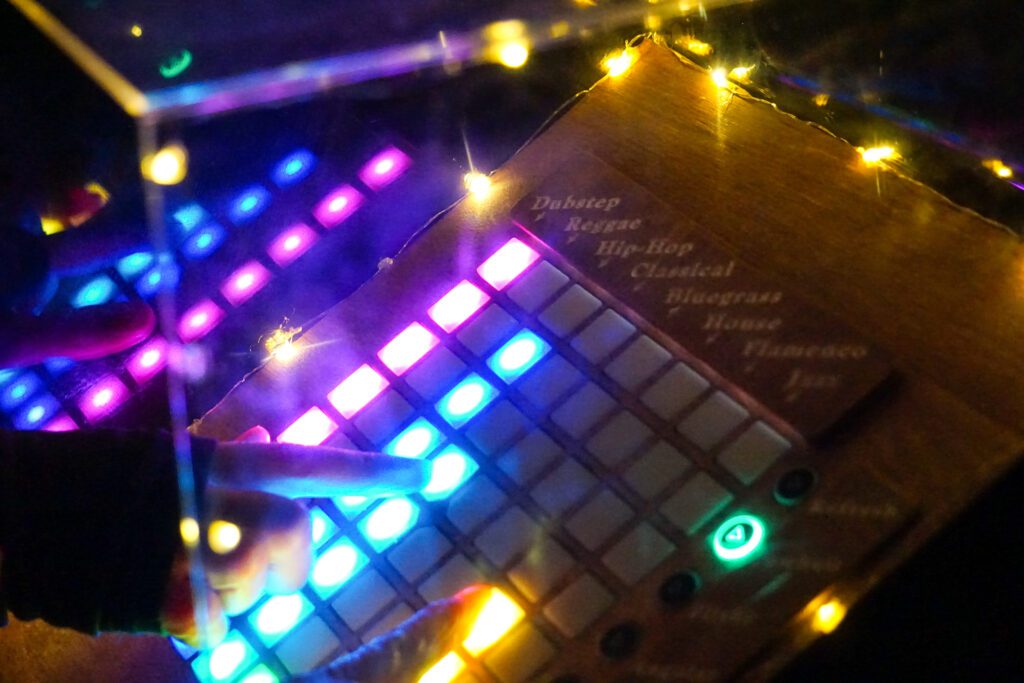
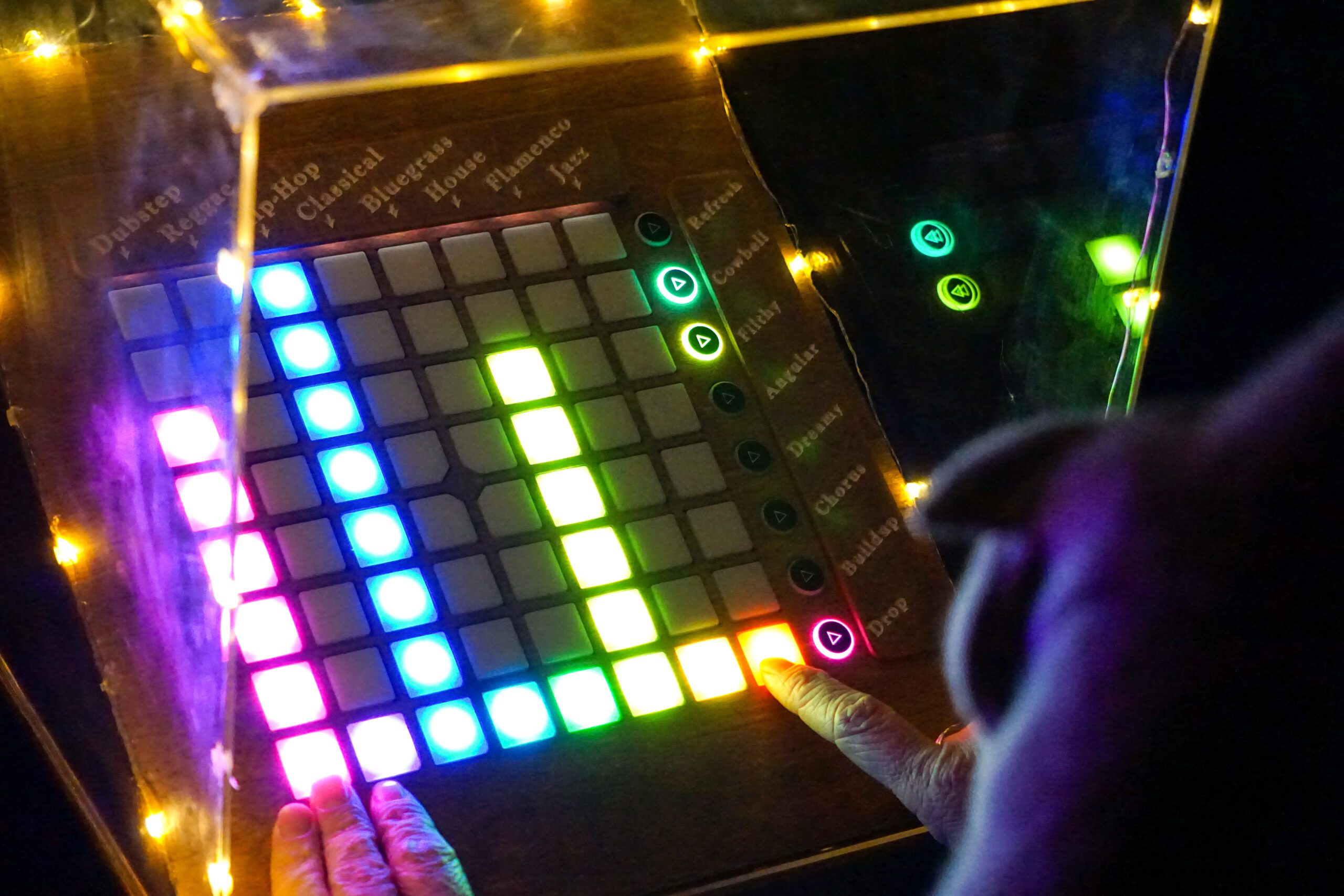
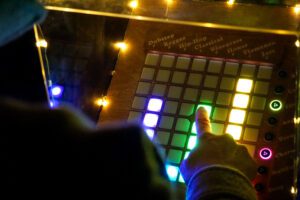
Sonic Tapestry contains a rustic wooden pedestal that conceals the speakers, interface (a MIDI pad), and computer, and has sound reactive lighting. The MIDI pad and device are protected with a clear acrylic covering. The MIDI pad is embedded into a custom laser cut platform, angling it towards the user and hiding the plastic with wood veneer to support the rustic aesthetic. Engraved wooden labels indicate the function of each button.
The user interface has an 8×8 grid for selecting a musical genre and the weight of each one, allowing for creative fusion or tapestry of musical genres blending through simple button presses. Selecting only eight genres is extremely difficult and I landed upon: dubstep, reggae, hip-hop, classical, bluegrass, house, flamenco, and jazz. There are eight buttons on the side used to control additional musical elements including emotional or textural qualities (such as dreamy, filthy, and angular), structural features (chorus, buildup, and drop), as well as refresh to restart and, of course, cowbell for, well, more cowbell.
The user selection is processed into a more detailed prompt (this was the hard part with lot of experimentation) and then processed by the genAI Lyria RealTime to generate snippets of audio. During use, the genAI takes into account what has been previously playing to ensure it sounds seamless.
How Lyria RealTime works. https://deepmind.google/models/lyria/lyria-realtime/
You can try out a web version of Lyria RealTime’s ‘Prompt DJ’ here.
Result
Sonic Tapestry was debuted at Victoria at Dusk 2026.
Watch / listen to how it works and remember to turn on your audio!