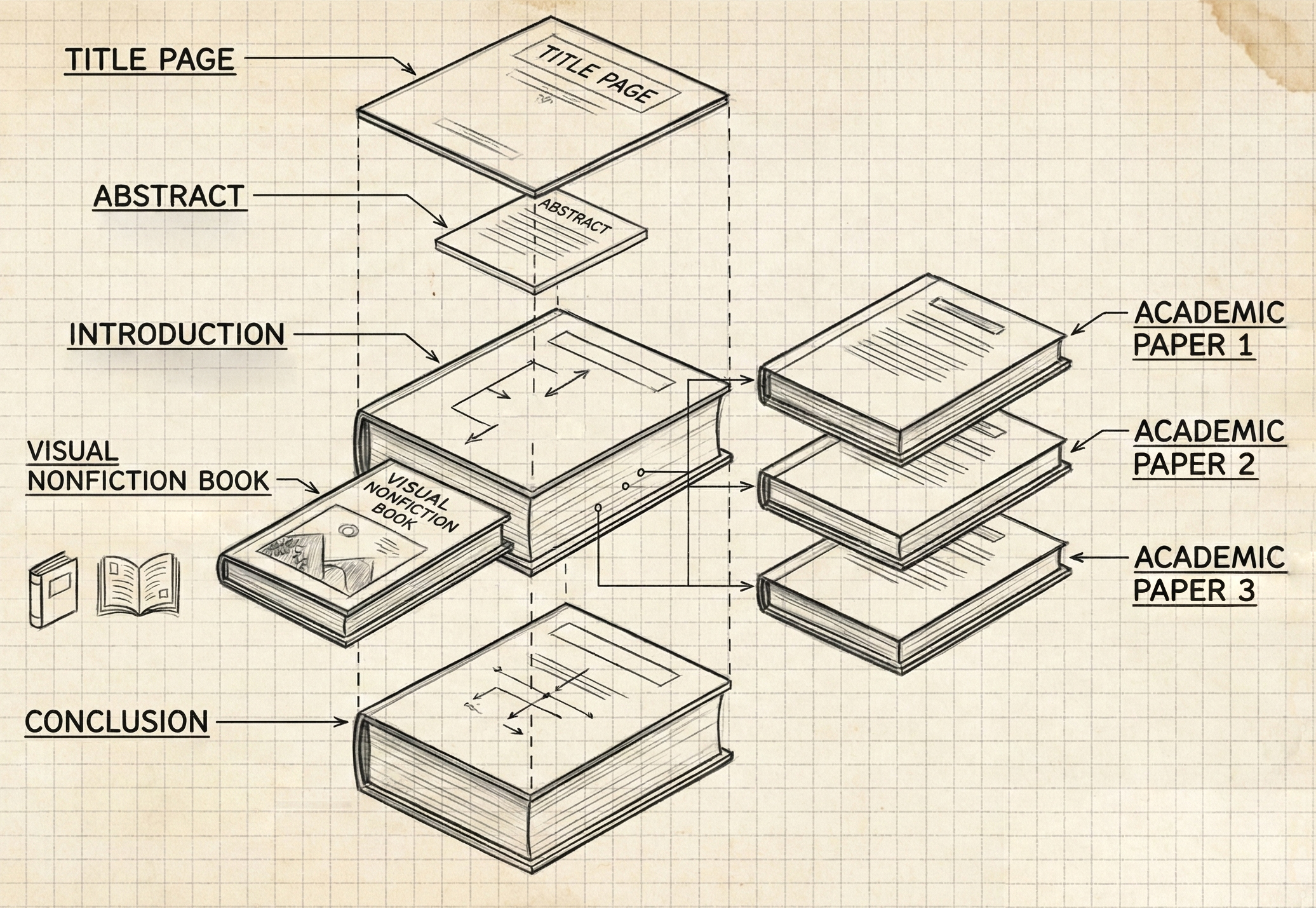
I reviewed three dissertations related to my interests to gain an understanding of what the final product of my own dissertation may look like. I initially searched for process-oriented assessment practices and process pedagogy. Somewhat surprisingly, this resulted in dissertations mostly in writing education. From my current understanding, process pedagogy can be applied across disciplines, and it is already utilized in math, science, design, and engineering, where process is fundamental. This warrants further exploration; it is possible that different terminologies are used across these disciplines.
When skimming dissertations to select which to review further, I noticed most fit the traditional structure. I wanted to review a three-paper dissertation as well and utilized and searched for the example shared of Dr. Mariel Miller’s dissertation.
This review process has highlighted the importance of ensuring a dissertation is accessible to readers. Not functionally but cognitively: how information is introduced and discussed as well as considering the experience as a whole.
I found it challenging to jump between sections of the dissertation to gain a quick working understanding, something that I have had success with research articles. Also, the use of acronyms was challenging, as I did not always see where they were first introduced. Reintroducing acronyms at the start of each chapter would significantly improve readability. If we were to take this accessibility concern further, I would challenge why we are bound to this academic format? Reviewing black and white, double-spaced blocks of text is such a poor experience and I find it so ironic since we, as educators, know all the intricacies of how and why the learning experience and design matters for understanding—APA 7 doesn’t even allow for adequate heading signaling/text hierarchy! I think about this nearly every time I read blocks of static text about active or multimedia learning. And I understand the reasoning of communicating nuanced meaning quickly and the constraints of time and resources, but come on … what about all that’s lost with our current explicit format? Friends in design fields have created beautiful and aesthetic dissertations while still maintaining academic rigor. I think there’s something we need to adopt here.
Aesthetic Dissertations
Snyman, T. T. (2018). Unmaking: Exploring agency through unmaking [Master’s thesis, Emily Carr University of Art + Design]. https://drive.google.com/file/d/1x7cjS0bWHqTNSJo3VrzsX4HP3X5rczsF/view
Druet, L. (2021). Making stories: Facilitating spatial agency through democratized design [Master’s thesis, University of Manitoba]. https://issuu.com/greyandivy/docs/240110_making_stories_facilitating_spatial_agency
Miller (2015)
Miller, M. F. W. (2015). Leveraging CSCL technology to support and research shared task perceptions in socially shared regulation of learning [Doctoral dissertation, University of Victoria]. https://dspace.library.uvic.ca/items/47fcebaa-1f58-47ae-b449-86af3865e590
Miller (2015) developed a three-paper dissertation on applying theoretical frameworks of self-, co-, and shared regulation in computer supported collaborative learning tools.
The main composition is:
- Introduction
- Theoretical Framework
- Research Purpose and Overview (with reference to the three manuscripts)
- Discussion: Promoting and Researching Shared Task Perceptions
The first article is a philosophical paper with theoretical argumentation exploring how the theoretical framework applies to the research context. The second and third article is original research observing students in two different undergraduate class as they progress through a group project. Qualitative data was coded along side timestamped logs.
Miller (2015) share that “findings bring new knowledge and opportunities to facilitate learners to develop skills for regulating teamwork” (p.69). As they set out to do, they extended previous models of self-regulated learning and applied them in computer supported collaborative learning tools.
Further research can be done to further extend this model into new contexts involving 21st century skills, over time, and/or to multiple social levels.
Turner (2023)
Turner, N. (2023). Development and assessment of gamified process-oriented guided inquiry learning activities in undergraduate large lecture chemistry courses [Doctoral dissertation, South Dakota State University]. OpenPRAIRIE. https://openprairie.sdstate.edu/etd2/611
Turner (2023) researched the effect of process-oriented guided inquiry and gamification on students’ learning in an undergraduate chemistry class. Process-oriented guided inquiry and gamification each offer their own theoretical framework. Process-oriented guided inquiry is strongly rooted in constructivism and gamification depends on how it is employed. The author did not explore its theoretical underpinning, but what was shared are largely behaviorist techniques (“points, badges, leader boards, levels” (p. 13). They also incorporate cognitive load theory with the rationale it is evident in both practices.
The main composition was consistent with a scientific research article with chapters of:
- Introduction
- Literature Review
- Methodology
- Results & Analysis
- Discussion, Implications & Conclusion
A quasi-experiment methodology was employed with a mixed method data acquisition. An intervention was designed and then utilized three times, first as a pilot, then in two experiments. Each time the intervention remained constant, but the research design was iterated upon.
The intervention was shown to be a success to learning. Specifically, process-oriented guided inquiry improved problem-solving skills while minimizing cognitive load. Gamification did not influence problem-solving skills but was found to be engaging.
Future work is needed to explore the validity of process-oriented guided inquiry and gamification teaching methodologies.
Peñaflorida (2021)
Peñaflorida, J. O. (2021). The intersection of writing process pedagogy and prolepsis: A phenomenological case study of secondary writing instruction [Doctoral dissertation, University of Arkansas, Fayetteville]. ScholarWorks@UARK. https://scholarworks.uark.edu/etd/4084
Peñaflorida (2021) explored the intersection of writing process pedagogy and a theorized writing framework. They began by exploring process pedagogy which built on sociocultural theory, a theory within constructivism. Process pedagogy is explored throughout its development: The Expressivist View (1960s-1970s), The Cognitive View (1970s-1980s), The Social View (1980-1990s), and The Postprocess View (1990s-Current)
There is an identical chapter composition as the previous dissertation reviewed:
- Introduction
- Theoretical Foundation
- Methods and Methodology
- Results
- Discussion, Implications & Conclusion
This dissertation employed a mixed-methods case study of eight high school students in a summer writing camp. Qualitative data was collected from a variety of sources including student interviews and pre-and-post writing samples. Pre-and-post writing samples were graded for evaluation of the intervention. Interviews and other qualitative data were coded and thematically analyzed.
The study confirmed a sociocultural view on writing education, in that a supported learning environment, consisting of other students, teachers, and guest speakers, positively shaped students’ writing and attitudes of it. It also found the developed writing framework as a helpful tool for instruction.
It is recommended that further research is needed on determining “the factors that lead to effective writing process pedagogy” (p. 97) and how digital (on-line) co-construction of knowledge can benefit writing classrooms.