This is a brief review of three academic journals that are applicable to my area of study. In choosing which journals to review, I turned to publications that I have found impactful throughout my SSHRC and literature review process. Prior to this process, I paid little attention to scholarly journals beyond their credibility.
Quickly, it became evident the amount of collaborative work it takes to create these journals and enormous influence they can have. It is exciting that several experts in a field select which articles contribute new knowledge to the discipline and are worthy of promotion. I can understand the value in following journals though at this time, I am still overwhelmed by the enormous number of journals as well as all of their publications. It is hard to imagine at this moment staying current with publications.
The three journals I reviewed are: Assessment & Evaluation in Higher Education, Educational Philosophy and Theory, and Big Data & Society. At first, I was hesitant to review two journals from the same publisher, but upon further research, they had some fundamental differences and similarities, outlining the extent of influence of a publisher. One resource that I came across and will prove useful, regardless of the publication journal, are details on how to get an article found through consideration of the title, abstract, and keywords: Using Keywords to Write your Title and Abstract
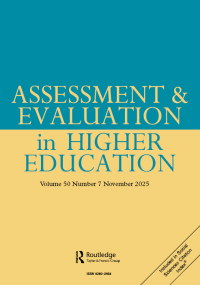
Assessment & Evaluation in Higher Education
Assessment & Evaluation in Higher Education is an international peer-reviewed academic journal published by the Taylor & Francis Group that was first published in 1975. They publish 8 issues per year with 10 – 12 articles per issue. The scope and objective are clear from the title as it covers “all aspects of assessment and evaluation within higher education … to advance understanding of assessment and evaluation practices and processes, particularly the contribution that these make to student learning and to course, staff and institutional development” (Taylor & Francis Group, n.d.-a).
The editorial board consists of ten members from various countries including, UK, Canada, Australia, New Zealand, and Hong Kong. Each member is university faculty with disciplinary expertise in either education or the social sciences more broadly. One member is designated as the editor and another as the book review editor.
Two article types are accepted: research articles (<7000 words), and data notes, a concise description of research data (<3000 words). Full details can be found in the Instructions for Authors.
Across the articles reviewed, there did not appear to be a focused methodology or approach as articles were quite diverse. They spanned the research methodologies, qualitative, quantitative, and mixed methods, and even a theoretical argumentation, though not listed as an accepted article type. Data acquisition included experimental methodologies as well historical datasets.
The fees and copyright were a bit harder to discover, hidden in different pages with fine print and a search query. While Taylor and Francis (n.d.-a) state “there are no submission fees, publication fees or page charges for this journal”, this is contingent on transferring or ‘assigning’ copyright of the article (Taylor & Francis Group, 2025). For publishing open access, it costs a whopping $4720 USD if the author is residing in Canada. Open access publishing fees could be waived “if the author’s institution or research funder has an open access agreement or an open access membership with Taylor & Francis” (Taylor & Francis Group, n.d.-c).
In addition, there are fees for colour figures in the print copy ($400 USD each for the first four then $75 after).
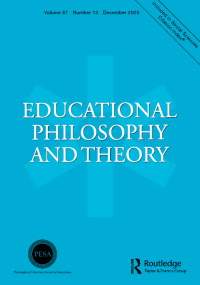
Educational Philosophy and Theory
Educational Philosophy and Theory, also published by the Taylor & Francis Group, was first published in 1969. They publish 14 issues per year with about 10-12 publications per issue spanning a variety of types. “The journal has published manuscripts concerned with curriculum theory, educational administration, the politics of education, educational history, educational policy, and higher education” (Taylor & Francis Group, n.d.-b). This academic journal encourages publications from authors beyond the discipline of education.
There is a large editorial board with the hierarchy of two editors-in-chief, one managing editor, one reviews editor, and nineteen other members. The editorial board spans numerous countries including as Canada, UK, New Zealand, Taiwan, South Africa, and India. Nearly every member’s primary discipline is in the philosophy of education (Google, 2025).
This journal accepts a variety of publications: original articles, invited guest editorials, responses to editorials, interviews, book reviews, and collective writing articles. Articles are typically published in a philosophical or theoretical argumentation format instead of the scientific format (literature review, methodology, findings, discussion). A typical paper is less than 6000 words. Full details can be found in the Instructions for Authors.
As publications are taking the form of philosophical or theoretical argumentation, they tend to not employ experimental methodologies. Instead, it appears most articles engage in critical theoretical debate offering reconsiderations and new insights.
The fee and copyright structure is the same as the other Taylor & Francis reviewed journal, Assessment & Evaluation in Higher Education, above, except for the cost to publish open access being $3650 USD.
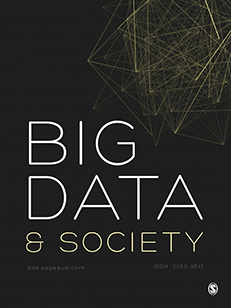
Big Data & Society
Big Data & Society is an open access scholarly journal published quarterly by SAGE Publications. It views with Big Data as an emerging field and is concerned with its implication for societies (“academic, social, industry, business and government relations, expertise, methods, concepts and knowledge” (SAGE Publications, n.d.)). Thus, it is interdisciplinary in nature, at the intersections of social sciences, humanities, computing, arts, and natural sciences. First published in 2014, each issue has 25 – 40 publications.
As a digital-only journal, it encourages authors to utilized rich media, and designs a rich multimedia experience by embedding all media, challenging the traditional print primary journal medium.
Big Data & Society has an enormous editorial board consisting of 73 members. Most members reside in Canada, UK, USA, and Europe, with other membership from Chile, Costa Rica, South Korea, Brazil, Taiwan, and Mexico. Further research by the LLM Gemini (2.5 Flash) (Google, 2025) revealed an interdisciplinary expertise across the editorial members, in-line with the interdisciplinary nature of the journal. The most represented disciplines included Digital Studies, Media and Communication, Science and Technology Studies, and Sociology (Google, 2025).
This journal accepts a variety of articles: research articles (<10,000 words), commentaries (<3000 words), and demonstrations of new methods, visualizations, experiments and approaches. The article processing charge is USD $2,250, which may be covered through the author’s institutional open-access agreement. If the submission is a research article and the authors lack funding, the publisher may waive the fee upon request. Additionally, it accepts contributions to its blog: essays and provocations, as well as blogs and video abstracts to support journal articles.
Original research articles tended not to employ experimental designs, instead analyzing data acquired from real-world contexts. Most of the articles reviewed did not focus directly on big data itself but instead employed qualitative methods to examine its societal implications.
References
Google. (2025). Gemini (Flash 2.5) [Large language model]. https://gemini.google.com/
SAGE Publications. (n.d.). Overview metric: Big Data & Society. https://journals.sagepub.com/overview-metric/BDS
Taylor & Francis Group. (2025). Understanding copyright for journal authors. Taylor & Francis Author Services. https://authorservices.taylorandfrancis.com/publishing-your-research/moving-through-production/copyright-for-journal-authors/
Taylor & Francis Group. (n.d.-a). Aims and scope. Assessment & Evaluation in Higher Education. https://www.tandfonline.com/journals/caeh20/about-this-journal#aims-and-scope
Taylor & Francis Group. (n.d.-b). Aims and scope. Educational Philosophy and Theory. https://www.tandfonline.com/journals/rept20/about-this-journal#aims-and-scope
Taylor & Francis Group. (n.d.-c). Open access cost finder. Author Services. https://authorservices.taylorandfrancis.com/choose-open/publishing-open-access/open-access-cost-finder/