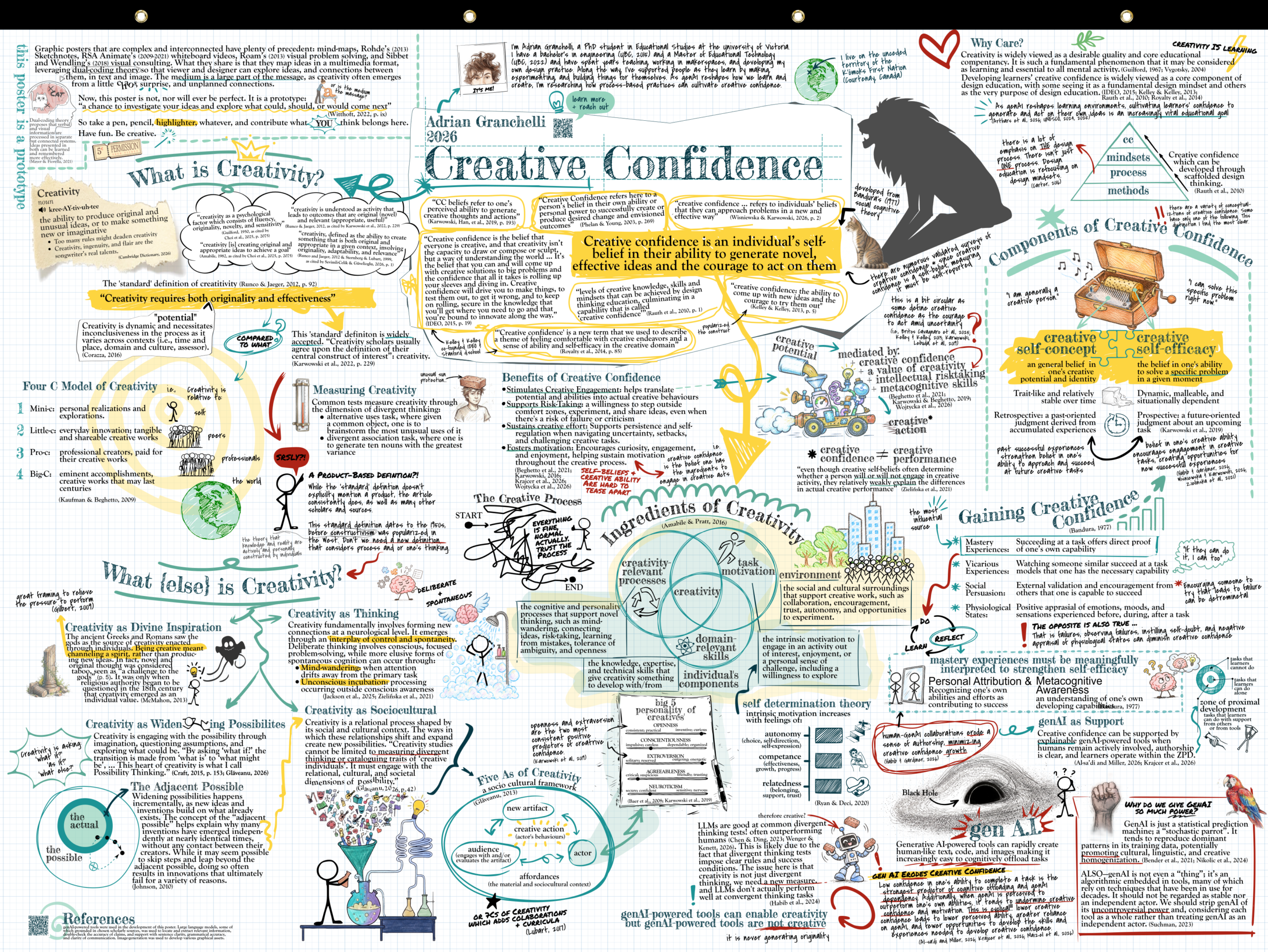
Creative confidence is the trust in one’s ability to generate creative ideas and act on them. It is a widely studied construct in creativity research, a predictor of creative performance, and a central goal of leading design education programs (e.g., Stanford d.school, IDEO U). GenAI-powered tools have changed how people create as genAI can produce creative products, with minimal input or creative thinking. While this can expand one’s capacity to create, it risks cognitive offloading, a sense of authorship, and ultimately lowers creative confidence. Research suggests that how people use genAI shapes these effects, with creative confidence supported when people explore and collaborate before using genAI, and when genAI tools are transparent, learning-oriented, and process-focused (Al-sa’di & Miller, 2026; Habib & Gardiner, 2026; Krajcer et al., 2026).
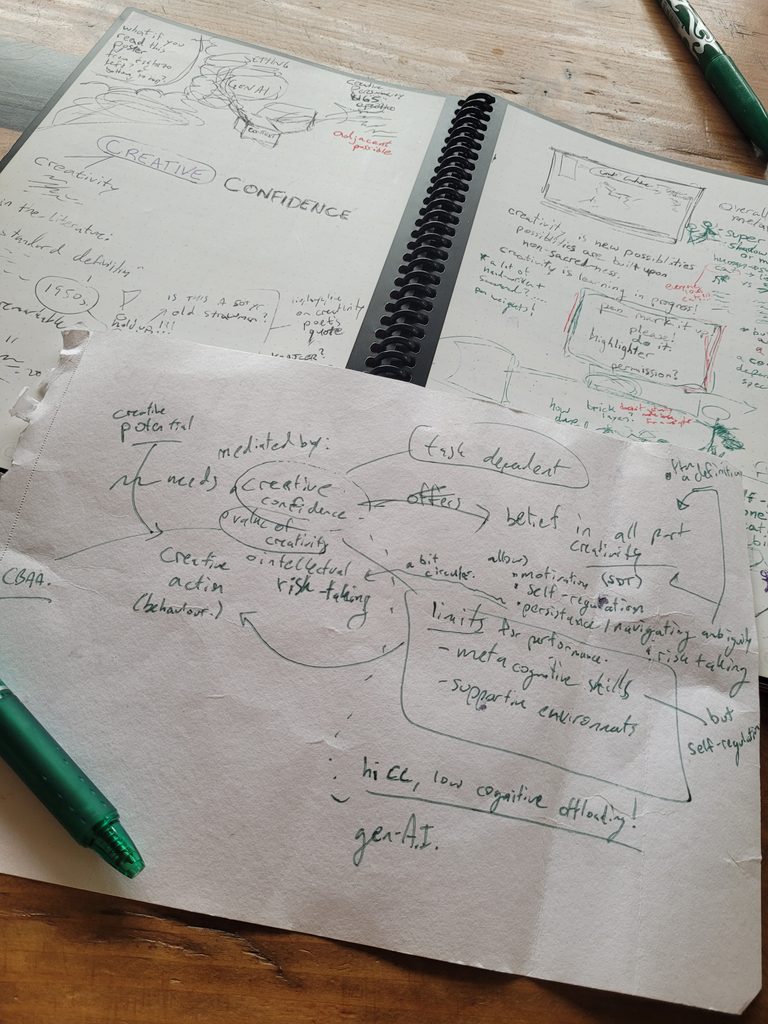
Creative confidence is malleable, shaped by experiences, and mediated by technological, social, and task-related conditions, including genAI use. The construct builds on Bandura’s (1977) self-efficacy, a person’s belief in their capability to succeed at a specific task, which develops through mastery experiences. Creative confidence is theorized to have two components: trait-like beliefs in one’s creative potential, built through past experiences, and context-specific belief in one’s ability to solve a particular problem (Karwowski et al., 2019).
This poster uses a non-linear format and reflects the system in which creative confidence develops. Four entry points explore the construct itself, creativity and design work, genAI-powered tools, and the system in which a creator acts, allowing viewers to choose their own path of engagement. Connections between the entry points highlight relationships and points of comparison.
Viewers will gain an understanding for deciding when and how to introduce genAI so that it supports rather than undermines creative confidence. The work is relevant to researchers preparing presentations, posters, and articles, and to instructors designing courses, assignments, and learning environments.
How It’s Made
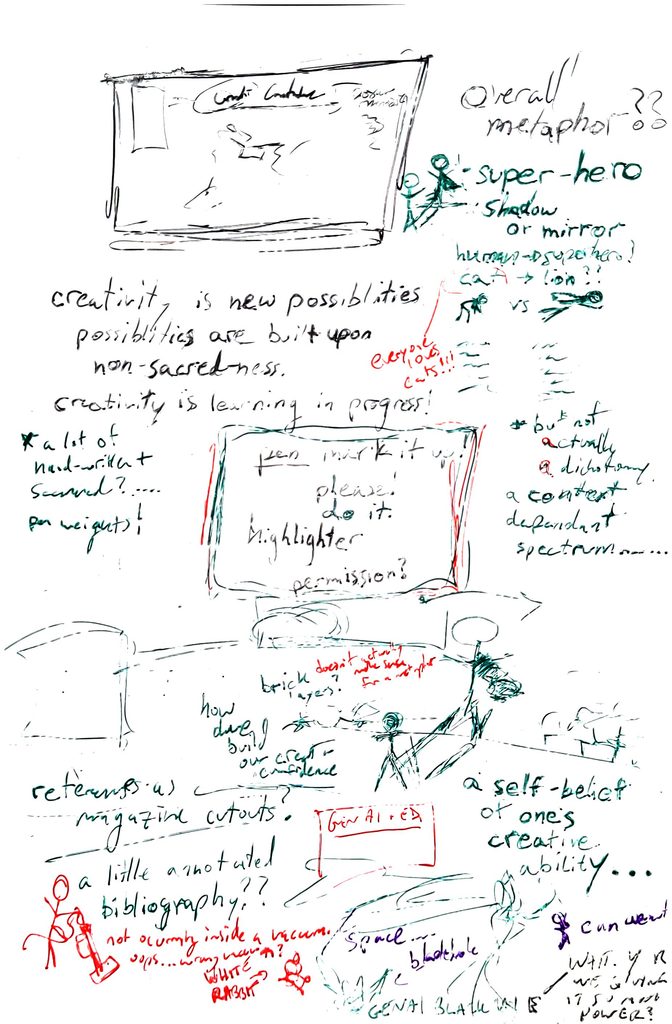
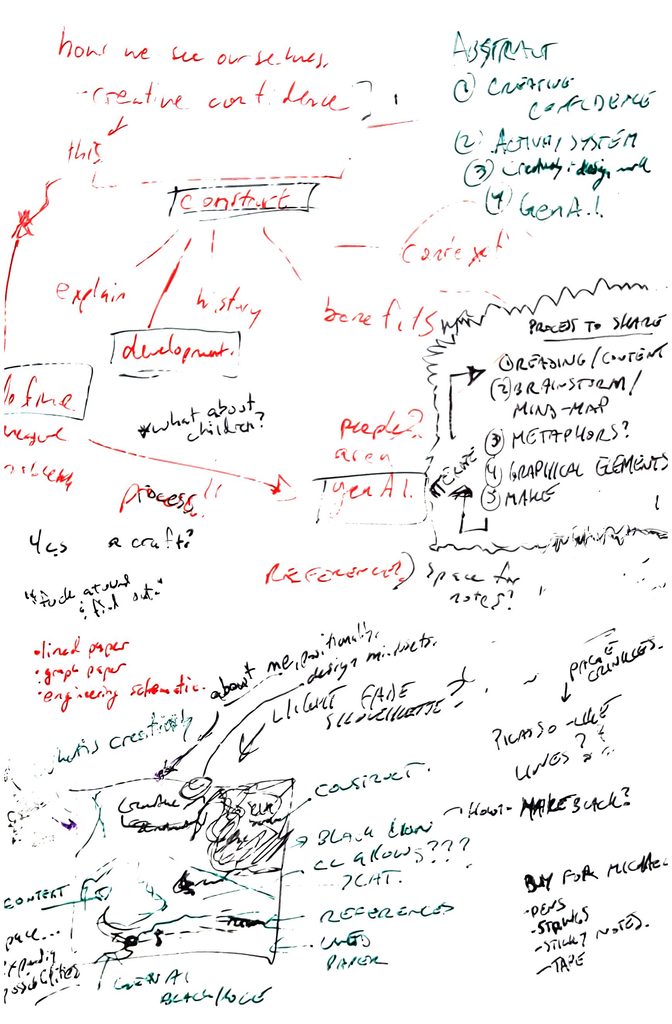
Briefly, my process in creating this poster included the following steps:
- Research into Creative Confidence, creativity, and the influences of genAI-powered tools
- Rough sketching, mapping, and brainstorming (sketches by hand)
- Metaphor development
- Designing graphical elements (I used an iterative combination of tools including the open-source vector design program, Inkscape, raster image editor, Adobe Photoshop, and ChatGPT txt-img)
- Pulling it all together (Inkscape)
and importantly, these process steps are iterative: I constantly moved through redesign as new connections and ideas were made at times leading me to return to further research, more sketches, metaphors, new graphical elements, etc …
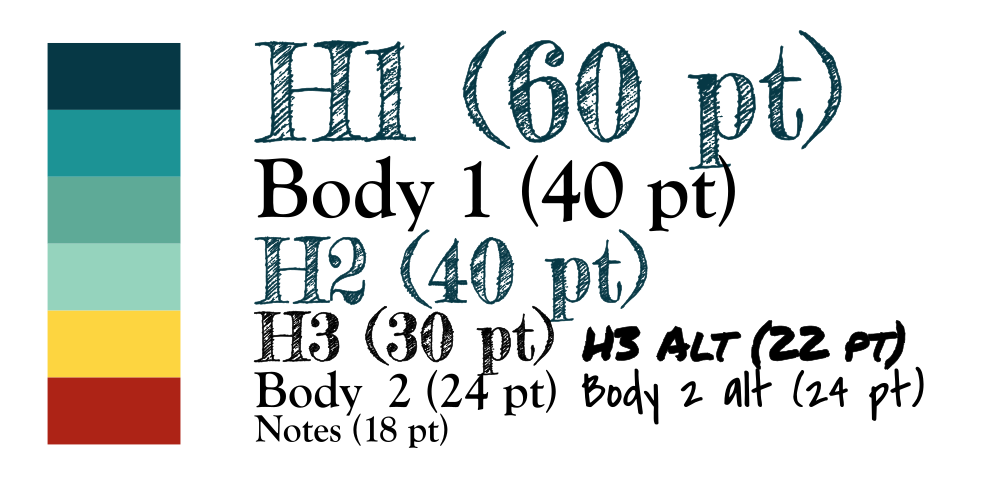
I largely took the style guide from this website (to save time). There are two main font types:
- a serif heading/body font that instill more of a formality (while the heading is half scribbled-in for an ‘in-progress’ or ‘roughness’)
- a handwritten heading/body font to depict commentary, push-back, or edits
I used genAI-powered tools throughout the process. Large language models, some of which grounded in chosen scholarly sources, was used to locate and extract relevant information, double-check the accuracy of claims, and support with sentence clarity, grammatical accuracy, and clarity of communication. Image-generation was used to develop various graphical assets.
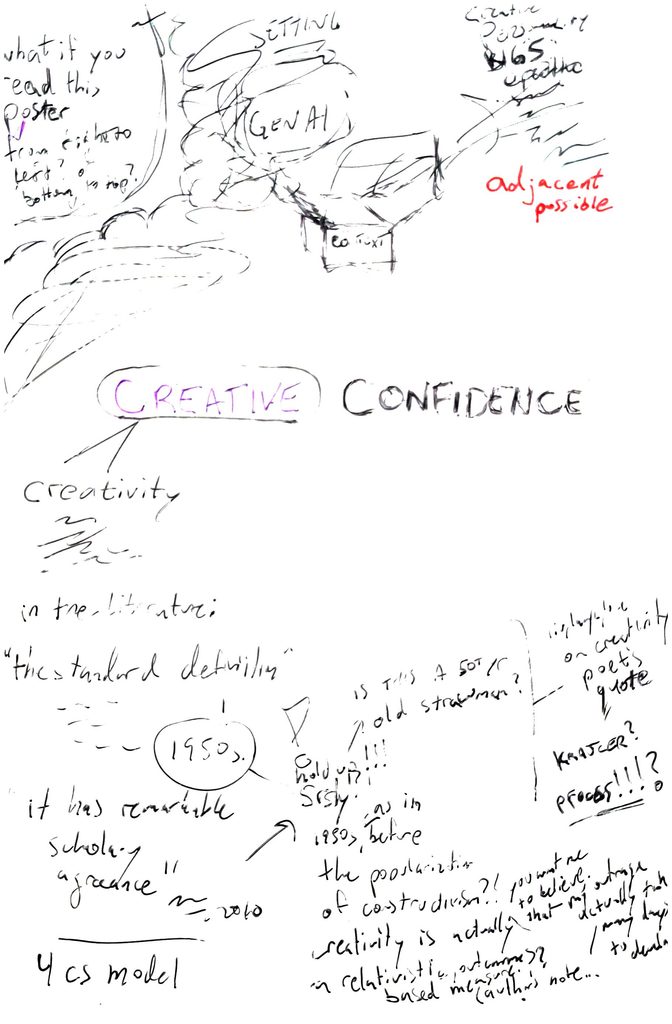
Rough Planning Sketches:
References
Adhikari, B. (2023). Thinking beyond Chatbots’ Threat to Education: Visualizations to Elucidate the Writing or Coding Process. Education Sciences, 13(9), 922. https://doi.org/10.3390/educsci13090922
Baker, S. E., & Edwards, R. (2012). How many qualitative interviews is enough? Expert voices and early career reflections on sampling and cases in qualitative research. National Centre for Research Methods. https://eprints.ncrm.ac.uk/id/eprint/2273/4/how_many_interviews.pdf
Barnhisel, G., Stoddard, E., & Gorman, J. (2012). Incorporating Process-Based Writing Pedagogy into First-Year Learning Communities: Strategies and Outcomes. The Journal of General Education, 61(4), 461–487. https://doi.org/10.1353/jge.2012.0041
Brinkmann, S., & Kvale, S. (2015). InterViews: Learning the craft of qualitative research interviewing (Third edition). Sage Publications.
Britos Cavagnaro, L. C., Estrada-Liou, E. D., Hnatov, C. L., Ta, T., & Lichtenstein, G. (2025). Assessing the ability to navigate ambiguity: An essential skill for imagining possible futures. Possibility Studies & Society, 27538699251375151. https://doi.org/10.1177/27538699251375151
Bulut, O. (2026). Survey Design 101.
Carter, C. (2016). Let’s Stop Talking about THE Design Process. Stanford d.School. https://medium.com/stanford-d-school/lets-stop-talking-about-the-design-process-7446e52c13e8
Chung, J., Henderson, M., Slade, C., Liang, Y., Pepperell, N., Corbin, T., Walton, J., Yu, A. S., Bearman, M., Shum, S. B., Fawns, T., McCluskey, T., McLean, J., Oberg, G., Seligmann, A., Shibani, A., Bakharia, A., Lim, L.-A., & Matthews, K. E. (2026). The use and usefulness of GenAI in higher education: Student experience and perspectives. Computers and Education Open, 100347. https://doi.org/10.1016/j.caeo.2026.100347
Creswell, J. W., & Creswell, J. D. (2023). Research design: Qualitative, quantitative, and mixed methods approaches (Sixth edition, international student edition). Sage.
de la Croix, A., Barrett, A., & Stenfors, T. (2018). How to…do research interviews in different ways. The Clinical Teacher, 15(6), 451–456. https://doi.org/10.1111/tct.12953
DeVellis, R. F., & Thorpe, C. T. (2022). Scale development: Theory and applications (Fifth edition). SAGE.
Dillman, D. A., Smyth, J. D., & Christian, L. M. (2014). Internet, phone, mail, and mixed-mode surveys: The tailored design method (4. ed). Wiley.
Eaton, S. E. (2023). Postplagiarism: Transdisciplinary ethics and integrity in the age of artificial intelligence and neurotechnology. International Journal for Educational Integrity, 19(1), 23, s40979-023-00144–1. https://doi.org/10.1007/s40979-023-00144-1
Fawns, T., & Schuwirth, L. (2024). Rethinking the value proposition of assessment at a time of rapid development in generative artificial intelligence. Medical Education, 58(1), 14–16. https://doi.org/10.1111/medu.15259
Gagich, M. (2025). Using Process-Based Pedagogical Assessment Practices to Challenge Generative AI in the Writing Classroom: In P. W. Wachira, X. Liu, & S. Koc (Eds.), Advances in Educational Marketing, Administration, and Leadership (pp. 1–32). IGI Global. https://doi.org/10.4018/979-8-3693-6351-5.ch001
Hammersley, M. (2013). What is qualitative research? https://library.oapen.org/handle/20.500.12657/58723
Holbert, N., Berland, M., & Kafai, Y. B. (2020). Introduction: Fifty Years of Constructionism. In N. Holbert, M. Berland, & Y. B. Kafai (Eds.), Designing Constructionist Futures (pp. 1–16). The MIT Press. https://doi.org/10.7551/mitpress/12091.003.0002
Lozano, L. M., García-Cueto, E., & Muñiz, J. (2008). Effect of the number of response categories on the reliability and validity of rating scales. Methodology: European Journal of Research Methods for the Behavioral and Social Sciences, 4(2), 73–79. (2008-06441-003). https://doi.org/10.1027/1614-2241.4.2.73
Mayan, M. J. (2023). Essentials of Qualitative Inquiry (2nd ed.). Routledge. https://doi.org/10.4324/b23331
Ministry of Labour. (2026). Minimum wage—Province of British Columbia. Province of British Columbia. https://www2.gov.bc.ca/gov/content/employment-business/employment-standards-advice/employment-standards/wages/minimum-wage
Nikolic, S., Sandison, C., Haque, R., Daniel, S., Grundy, S., Belkina, M., Lyden, S., Hassan, G. M., & Neal, P. (2024). ChatGPT, Copilot, Gemini, SciSpace and Wolfram versus higher education assessments: An updated multi-institutional study of the academic integrity impacts of Generative Artificial Intelligence (GenAI) on assessment, teaching and learning in engineering. Australasian Journal of Engineering Education, 29(2), 126–153. https://doi.org/10.1080/22054952.2024.2372154
Norman, D. A. (2013). The design of everyday things (Revised and expanded ed). Basic Books.
Nunnally, J. C., & Bernstein, I. H. (1994). Psychometric theory (3. ed., [Nachdr.]). McGraw-Hill.
Packer, M. J. (2018). The Science of Qualitative Research: (2nd ed.). Cambridge University Press. https://doi.org/10.1017/9781108264907
Papert, S. (1984). New Theories for New Learnings. School Psychology Review, 13(4), 422–428. https://doi.org/10.1080/02796015.1984.12085122
Pasmore, W., Winby, S., Mohrman, S. A., & Vanasse, R. (2019). Reflections: Sociotechnical Systems Design and Organization Change. Journal of Change Management, 19(2), 67–85. https://doi.org/10.1080/14697017.2018.1553761
Pea, R. D. (1993). Practices of distributed intelligence and designs for education. In G. Salomon (Ed.), Distributed cognitions: Psychological and educational considerations (pp. 47–87). Cambridge University Press.
Podsakoff, P. M., MacKenzie, S. B., Jeong-Yeon Lee, & Podsakoff, N. P. (2003). Common Method Biases in Behavioral Research: A Critical Review of the Literature and Recommended Remedies. Journal of Applied Psychology, 88(5), 879. https://doi.org/10.1037/0021-9010.88.5.879
Roulston, K. (2010). Reflective interviewing: A guide to theory and practice. Sage.
Saldaña, J. (2011). Fundamentals of qualitative research. Oxford University Press.
Schön, D. A. (2013). The reflective practitioner: How professionals think in action. Ashgate.
Seidman, I. (2019). Interviewing as qualitative research: A guide for researchers in education and the social sciences (Fifth edition). Teachers College Press.
Suchman, L. (2023). The uncontroversial ‘thingness’ of AI. Big Data & Society, 10(2), 20539517231206794. https://doi.org/10.1177/20539517231206794
Tabachnick, B. G., & Fidell, L. S. (2019). Using multivariate statistics (Seventh edition). Pearson. Wolf, E. J., Harrington, K. M., Clark, S. L., & Miller, M. W. (2013). Sample Size Requirements for Structural Equation Models: An Evaluation of Power, Bias, and Solution Propriety. Educational and Psychological Measurement, 73(6), 913–934. https://doi.org/10.1177/0013164413495237